we provide Breathing Microsoft DP-300 testing engine which are the best for clearing DP-300 test, and to get certified by Microsoft Administering Relational Databases on Microsoft Azure (beta). The DP-300 Questions & Answers covers all the knowledge points of the real DP-300 exam. Crack your Microsoft DP-300 Exam with latest dumps, guaranteed!
Online Microsoft DP-300 free dumps demo Below:
NEW QUESTION 1
Note: This question is part of a series of questions that present the same scenario. Each question in the series contains a unique solution that might meet the stated goals. Some question sets might have more than one correct solution, while others might not have a correct solution.
After you answer a question in this section, you will NOT be able to return to it. As a result, these questions will not appear in the review screen.
You have two Azure SQL Database servers named Server1 and Server2. Each server contains an Azure SQL database named Database1.
You need to restore Database1 from Server1 to Server2. The solution must replace the existing Database1 on Server2.
Solution: From Microsoft SQL Server Management Studio (SSMS), you rename Database1 on Server2 as Database2. From the Azure portal, you create a new database on Server2 by restoring the backup of Database1 from Server1, and then you delete Database2.
Does this meet the goal?
- A. Yes
- B. No
Answer: B
Explanation:
Instead restore Database1 from Server1 to the Server2 by using the RESTORE Transact-SQL command and the REPLACE option.
Note: REPLACE should be used rarely and only after careful consideration. Restore normally prevents accidentally overwriting a database with a different database. If the database specified in a RESTORE statement already exists on the current server and the specified database family GUID differs from the database family GUID recorded in the backup set, the database is not restored. This is an important safeguard.
Reference:
https://docs.microsoft.com/en-us/sql/t-sql/statements/restore-statements-transact-sql
NEW QUESTION 2
You are monitoring an Azure Stream Analytics job.
You discover that the Backlogged input Events metric is increasing slowly and is consistently non-zero. You need to ensure that the job can handle all the events.
What should you do?
- A. Remove any named consumer groups from the connection and use $default.
- B. Change the compatibility level of the Stream Analytics job.
- C. Create an additional output stream for the existing input stream.
- D. Increase the number of streaming units (SUs).
Answer: D
Explanation:
Backlogged Input Events: Number of input events that are backlogged. A non-zero value for this metric implies that your job isn't able to keep up with the number of incoming events. If this value is slowly increasing or consistently non-zero, you should scale out your job, by increasing the SUs.
Reference:
https://docs.microsoft.com/en-us/azure/stream-analytics/stream-analytics-monitoring
NEW QUESTION 3
You have an Azure SQL database named DB1 in the General Purpose service tier. The performance metrics for DB1 are shown in the following exhibit.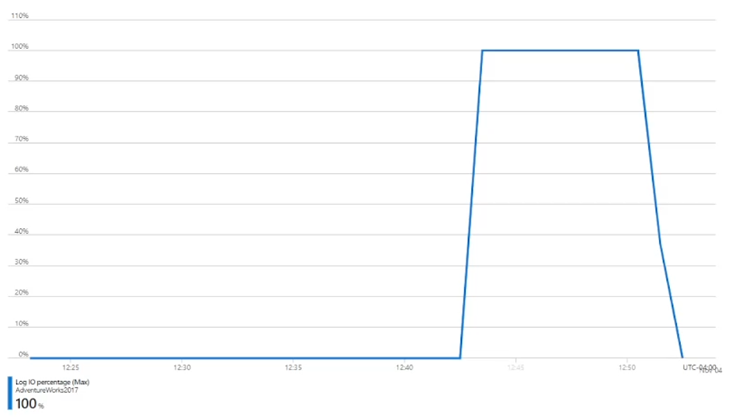
You need to reduce the Log 10 percentage. The solution must minimize costs. What should you do?
- A. Increase the number of vCores.
- B. Change RecoverymodeltoSimple.
- C. Performacheckpoint operation.
- D. ChangeService tier toBusiness Critical.
Answer: D
NEW QUESTION 4
You have an Azure data factory that has two pipelines named PipelineA and PipelineB. PipelineA has four activities as shown in the following exhibit.
PipelineB has two activities as shown in the following exhibit.
You create an alert for the data factory that uses Failed pipeline runs metrics for both pipelines and all failure types. The metric has the following settings: Operator: Greater than Aggregation type: Total Threshold value: 2 Aggregation granularity (Period): 5 minutes Frequency of evaluation: Every 5 minutes
Data Factory monitoring records the failures shown in the following table.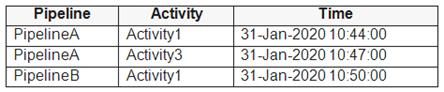
For each of the following statements, select Yes if the statement is true. Otherwise, select No.
NOTE:Each correct selection is worth one point.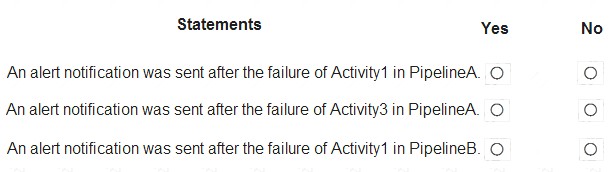
Solution:
Text Description automatically generated
Box 1: No
Just one failure within the 5-minute interval. Box 2: No
Just two failures within the 5-minute interval. Box 3: No
Just two failures within the 5-minute interval. Reference:
https://docs.microsoft.com/en-us/azure/azure-monitor/alerts/alerts-metric-overview
Does this meet the goal?
- A. Yes
- B. Not Mastered
Answer: A
NEW QUESTION 5
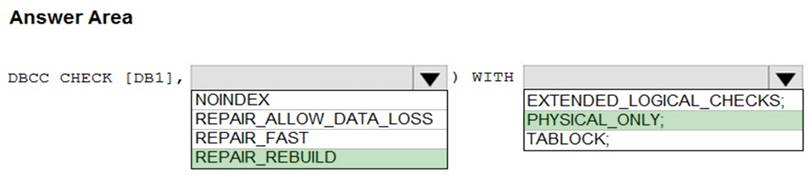
You have a SQL Server on Azure Virtual Machines instance that hosts a 10-TB SQL database named DB1. You need to identify and repair any physical or logical corruption in DB1. The solution must meet the
following requirements:
• Minimize how long it takes to complete the procedure.
• Minimize data loss.
How should you complete the command? To answer, select the appropriate options in the answer area NOTE: Each correct selection is worth one point.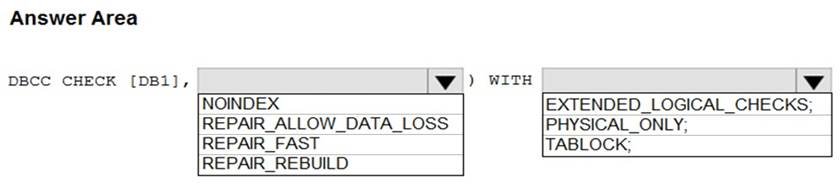
Solution:
Does this meet the goal?
- A. Yes
- B. Not Mastered
Answer: A
NEW QUESTION 6
You have an on-premises Microsoft SQL server that uses the FileTables and Filestream features. You plan to migrate to Azure SQL.
Which service should you use?
- A. Azure SQL Database
- B. SQL Server on an Azure Virtual Machine
- C. Azure SQL Managed Instance
- D. Azure Database for MySQL
Answer: B
Explanation:
Reference:
https://docs.microsoft.com/en-us/azure/azure-sql/migration-guides/database/sql-server-to-sql-database-overview
NEW QUESTION 7
You have SQL Server 2019 on an Azure virtual machine that contains an SSISDB database. A recent failure causes the master database to be lost.
You discover that all Microsoft SQL Server integration Services (SSIS) packages fail to run on the virtual
machine.
Which four actions should you perform in sequence to resolve the issue? To answer, move the appropriate actions from the list of actions to the answer area and arrange them in the correct.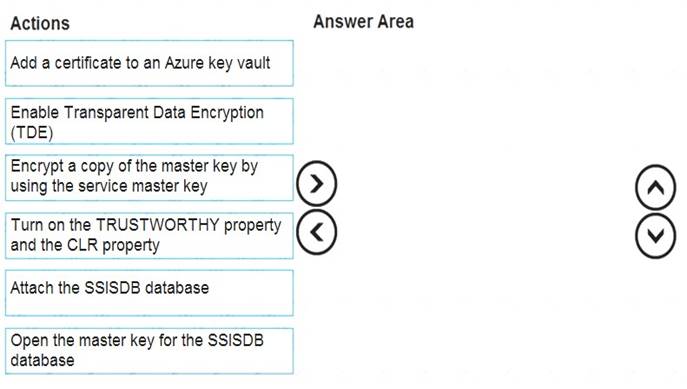
Solution:
Step 1: Attach the SSISDB database
Step 2: Turn on the TRUSTWORTHY property and the CLR property
If you are restoring the SSISDB database to an SQL Server instance where the SSISDB catalog was never created, enable common language runtime (clr)
Step 3: Open the master key for the SSISDB database
Restore the master key by this method if you have the original password that was used to create SSISDB.
open master key decryption by password = 'LS1Setup!' --'Password used when creating SSISDB' Alter Master Key Add encryption by Service Master Key
Step 4: Encrypt a copy of the mater key by using the service master key Reference:
https://docs.microsoft.com/en-us/sql/integration-services/backup-restore-and-move-the-ssis-catalog
Does this meet the goal?
- A. Yes
- B. Not Mastered
Answer: A
NEW QUESTION 8
You have an Azure SQL database.
Users report that the executions of a stored procedure are slower than usual. You suspect that a regressed query is causing the performance issue.
You need to view the query execution plan to verify whether a regressed query is causing the issue. The solution must minimize effort.
What should you use?
- A. Performance Recommendations in the Azure portal
- B. Extended Events in Microsoft SQL Server Management Studio (SSMS)
- C. Query Store in Microsoft SQL Server Management Studio (SSMS)
- D. Query Performance Insight in the Azure portal
Answer: C
Explanation:
Use the Query Store Page in SQL Server Management Studio.
Query performance regressions caused by execution plan changes can be non-trivial and time consuming to resolve.
Since the Query Store retains multiple execution plans per query, it can enforce policies to direct the Query Processor to use a specific execution plan for a query. This is referred to as plan forcing. Plan forcing in Query Store is provided by using a mechanism similar to the USE PLAN query hint, but it does not require any change in user applications. Plan forcing can resolve a query performance regression caused by a plan change in a very short period of time.
Reference:
https://docs.microsoft.com/en-us/sql/relational-databases/performance/monitoring-performance-by-using-the-qu
NEW QUESTION 9
You are planning a solution that will use Azure SQL Database. Usage of the solution will peak from October 1 to January 1 each year.
During peak usage, the database will require the following:  24 cores 500 GB of storage 124 GB of memory More than 50,000 IOPS
During periods of off-peak usage, the service tier of Azure SQL Database will be set to Standard. Which service tier should you use during peak usage?
- A. Business Critical
- B. Premium
- C. Hyperscale
Answer: A
Explanation:
Reference:
https://docs.microsoft.com/en-us/azure/azure-sql/database/resource-limits-vcore-single-databases#business-critic
NEW QUESTION 10
You have an Azure Data Factory that contains 10 pipelines.
You need to label each pipeline with its main purpose of either ingest, transform, or load. The labels must be available for grouping and filtering when using the monitoring experience in Data Factory.
What should you add to each pipeline?
- A. an annotation
- B. a resource tag
- C. a run group ID
- D. a user property
- E. a correlation ID
Answer: A
Explanation:
Azure Data Factory annotations help you easily filter different Azure Data Factory objects based on a tag. You can define tags so you can see their performance or find errors faster.
Reference:
https://www.techtalkcorner.com/monitor-azure-data-factory-annotations/
NEW QUESTION 11
You have a data warehouse in Azure Synapse Analytics.
You need to ensure that the data in the data warehouse is encrypted at rest. What should you enable?
- A. Transparent Data Encryption (TDE)
- B. Advanced Data Security for this database
- C. Always Encrypted for all columns
- D. Secure transfer required
Answer: A
Explanation:
Transparent data encryption (TDE) helps protect Azure SQL Database, Azure SQL Managed Instance, and
Azure Synapse Analytics against the threat of malicious offline activity by encrypting data at rest. Reference:
https://docs.microsoft.com/en-us/azure/azure-sql/database/transparent-data-encryption-tde-overview
NEW QUESTION 12
You have SQL Server on an Azure virtual machine that contains a database named DB1. The database reports a CHECKSUM error.
You need to recover the database.
How should you complete the statements? To answer, select the appropriate options in the answer area.
NOTE:Each correct selection is worth one point.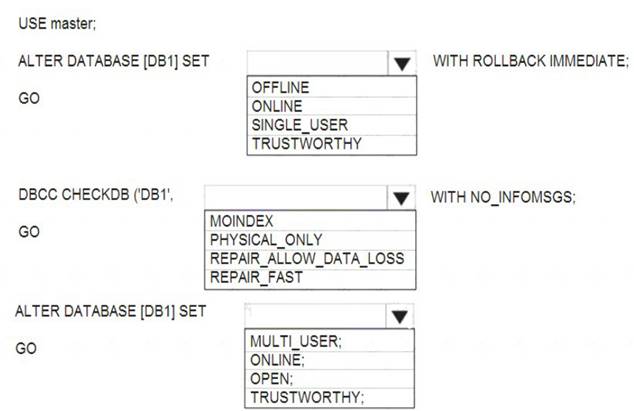
Solution:
Box 1: SINGLE_USER
The specified database must be in single-user mode to use one of the following repair options. Box 2: REPAIR_ALLOW_DATA_LOSS
REPAIR_ALLOW_DATA_LOSS tries to repair all reported errors. These repairs can cause some data loss.
Note: The REPAIR_ALLOW_DATA_LOSS option is a supported feature but it may not always be the best option for bringing a database to a physically consistent state. If successful, the REPAIR_ALLOW_DATA_LOSS option may result in some data loss. In fact, it may result in more data lost than if a user were to restore the database from the last known good backup.
Reference:
https://docs.microsoft.com/en-us/sql/t-sql/database-console-commands/dbcc-checkdb-transact-sql
Does this meet the goal?
- A. Yes
- B. Not Mastered
Answer: A
NEW QUESTION 13
You have an Azure subscription.
You plan to deploy an instance of SQL Sevier on Azure Virtual Machines that supports Write Accelerator.
Which virtual machine series should you use?
- A. H-series
- B. G -series
- C. M-series
- D. E-series
Answer: C
NEW QUESTION 14
Your on-premises network contains a Microsoft SQL Server 2016 server that hosts a database named db1. You have an Azure subscription.
You plan to migrate db1 to an Azure SQL managed instance.
You need to create the SQL managed instance. The solution must minimize the disk latency of the instance. Which service tier should you use?
- A. Hyperscale
- B. General Purpose
- C. Premium
- D. Business Critical
Answer: D
NEW QUESTION 15
You have an on-premises Microsoft SQL Server 2019 instance that hosts a database named DB1.
You plan to perform an online migration of DB1 to an Azure SQL managed instance by using the Azure Database Migration Service.
You need to create a backup of DB1 that is accessible to the Azure Database Migration Service.
What should you run for the backup and where should you store the backup? To answer, select the appropriate options in the answer area.
NOTE:Each correct selection is worth one point.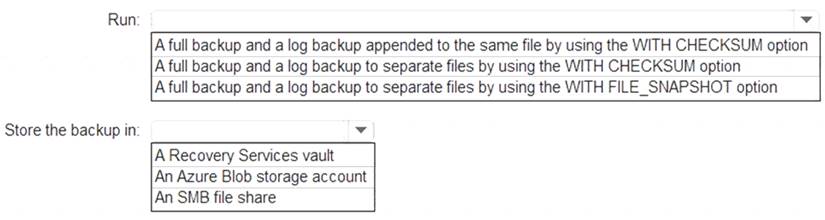
Solution:
Graphical user interface, application, Word Description automatically generated
Reference:
https://docs.microsoft.com/en-us/azure/dms/tutorial-sql-server-managed-instance-online
Does this meet the goal?
- A. Yes
- B. Not Mastered
Answer: A
NEW QUESTION 16
You have two Azure virtual machines named VM1 and VM2 that run Windows Server 2019. VM1 and VM2 each host a default Microsoft SQL Server 2019 instance. VM1 contains a database named DB1 that is backed up to a file named D:\DB1.bak.
You plan to deploy an Always On availability group that will have the following configurations:  VM1 will host the primary replica of DB1. VM2 will host a secondary replica of DB1.
You need to prepare the secondary database on VM2 for the availability group.
How should you complete the Transact-SQL statement? To answer, select the appropriate options in the answer area.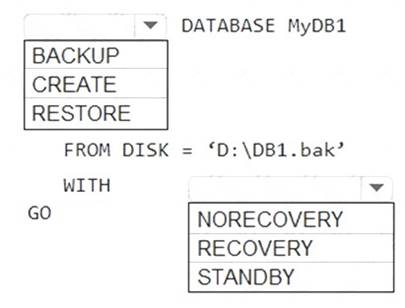
Solution:
Graphical user interface, text, application, chat or text message Description automatically generated
Reference:
https://docs.microsoft.com/en-us/sql/database-engine/availability-groups/windows/manually-prepare-a-secondar
Does this meet the goal?
- A. Yes
- B. Not Mastered
Answer: A
NEW QUESTION 17
You have an on-premises Microsoft SQL Server 2019 instance named SQL1 that hosts a database named db1. You have an Azure subscription that contains an Azure SQL managed instance named MI1 and an Azure Storage account named storage1.
You need to ensure that you can back up db1 to storage1. The solution must meet the following requirements:
* Use block blob storage.
* Maximize security.
- A. Generate a shared access signature (SAS)
- B. Enable infrastructure encryption.
- C. Create an access policy.
- D. Rotate the storage keys
Answer: B
NEW QUESTION 18
......
Thanks for reading the newest DP-300 exam dumps! We recommend you to try the PREMIUM Downloadfreepdf.net DP-300 dumps in VCE and PDF here: https://www.downloadfreepdf.net/DP-300-pdf-download.html (333 Q&As Dumps)