It is more faster and easier to pass the CompTIA CS0-003 exam by using Best Quality CompTIA CompTIA CySA+ Certification Beta Exam questuins and answers. Immediate access to the Regenerate CS0-003 Exam and find the same core area CS0-003 questions with professionally verified answers, then PASS your exam with a high score now.
Also have CS0-003 free dumps questions for you:
NEW QUESTION 1
During an incident, analysts need to rapidly investigate by the investigation and leadership teams. Which of the following best describes how PII should be safeguarded during an
incident?
- A. Implement data encryption and close the data so only the company has access.
- B. Ensure permissions are limited in the investigation team and encrypt the data.
- C. Implement data encryption and create a standardized procedure for deleting data that is no longer needed.
- D. Ensure that permissions are open only to the company.
Answer: B
Explanation:
The best option to safeguard PII during an incident is to ensure permissions are limited in the investigation team and encrypt the data. This is because limiting permissions reduces the risk of unauthorized access or leakage of sensitive data, and encryption protects the data from being read or modified by anyone who does not have the decryption key. Option A is not correct because closing the data may hinder the investigation process and prevent collaboration with other parties who may need access to the data. Option C is not correct because deleting data that is no longer needed may violate legal or regulatory requirements for data retention, and may also destroy potential evidence for the incident. Option D is not correct because opening permissions to the company may expose the data to more people than necessary, increasing the risk of compromise or misuse.
References: CompTIA CySA+ Study Guide: Exam CS0-002, 2nd Edition, Chapter 4, “Data Protection and Privacy Practices”, page 195; CompTIA CySA+ Certification Exam Objectives Version 4.0, Domain 4.0 “Compliance and Assessment”, Objective 4.1 “Given a scenario, analyze data as part of a security incident”, Sub-objective “Data encryption”, page 23
CompTIA CySA+ Study Guide: Exam CS0-002, 2nd Edition : CompTIA CySA+ Certification Exam Objectives Version 4.0.pdf)
NEW QUESTION 2
SIMULATION
You are a cybersecurity analyst tasked with interpreting scan data from Company As servers You must verify the requirements are being met for all of the servers and recommend changes if you find they are not
The company's hardening guidelines indicate the following
• TLS 1 2 is the only version of TLS running.
• Apache 2.4.18 or greater should be used.
• Only default ports should be used.
INSTRUCTIONS
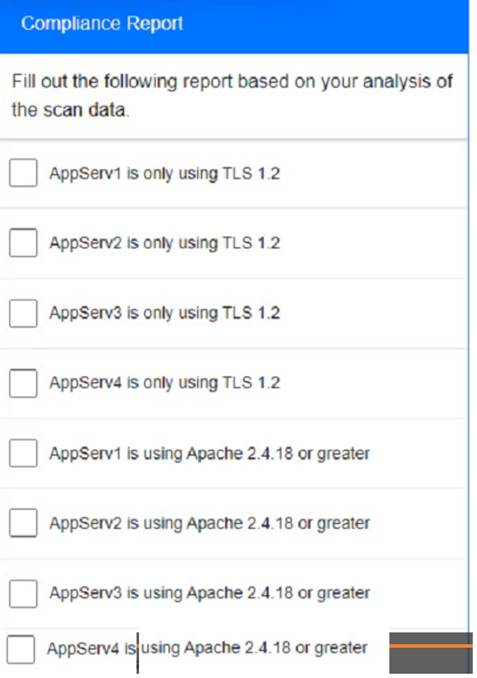
using the supplied data. record the status of compliance With the company’s guidelines for each server.
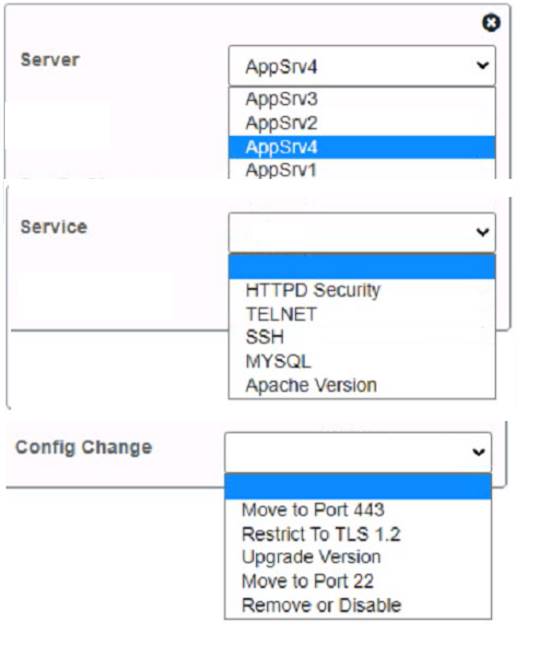
The question contains two parts: make sure you complete Part 1 and Part 2. Make recommendations for Issues based ONLY on the hardening guidelines provided.
Part 1: AppServ1: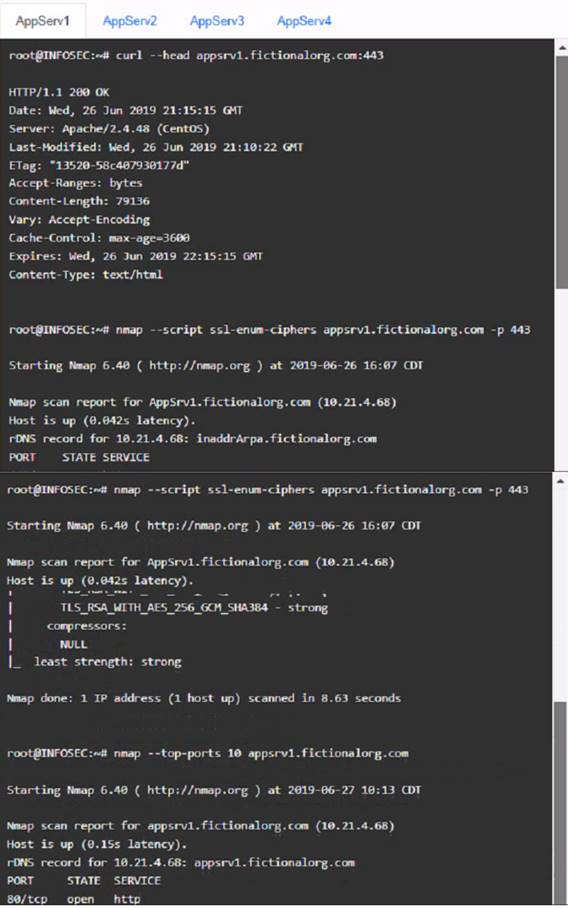
AppServ2: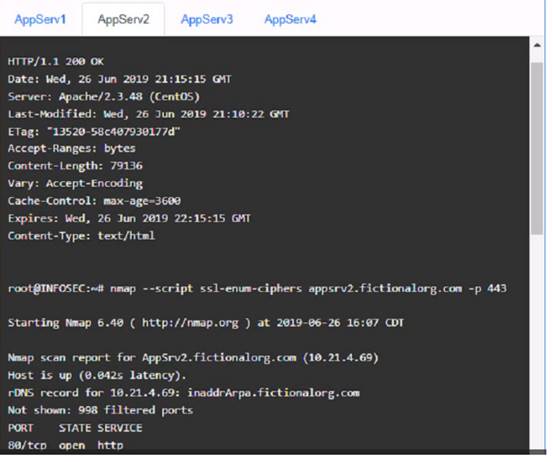
AppServ3: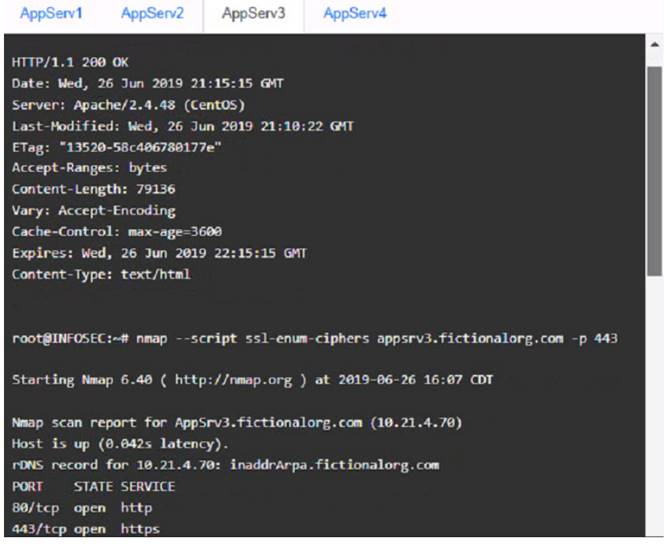
AppServ4: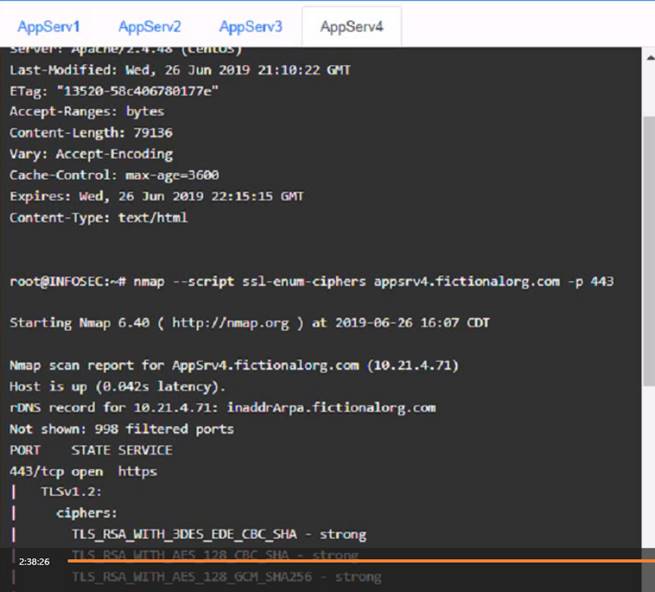
Part 2: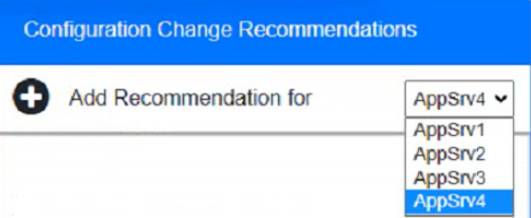
Solution:
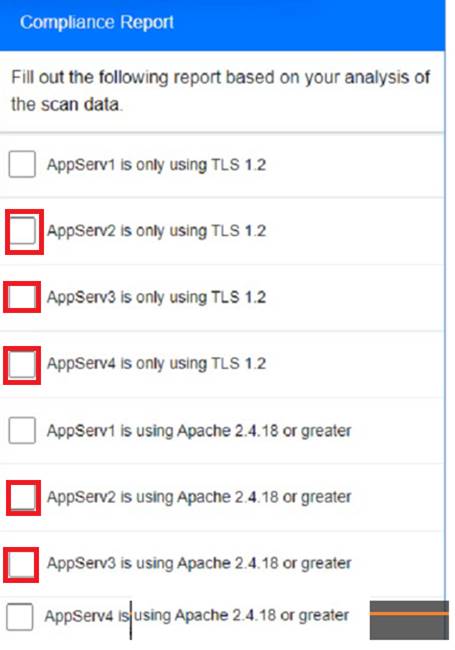
Part 1:
Part 2:
Based on the compliance report, I recommend the following changes for each server: AppServ1: No changes are needed for this server.
AppServ2: Disable or upgrade TLS 1.0 and TLS 1.1 to TLS 1.2 on this server to ensure secure encryption and communication between clients and the server. Update Apache from version 2.4.17 to version 2.4.18 or greater on this server to fix any potential vulnerabilities or bugs.
AppServ3: Downgrade Apache from version 2.4.19 to version 2.4.18 or lower on this server to ensure compatibility and stability with the company’s applications and policies. Change the port number from 8080 to either port 80 (for HTTP) or port 443 (for HTTPS) on this server to follow the default port convention and avoid any confusion or conflicts with other services.
AppServ4: Update Apache from version 2.4.16 to version 2.4.18 or greater on this server to fix any potential vulnerabilities or bugs. Change the port number from 8443 to either port 80 (for HTTP) or port 443 (for HTTPS) on this server to follow the default port convention and avoid any confusion or conflicts with other services.
Does this meet the goal?
- A. Yes
- B. Not Mastered
Answer: A
NEW QUESTION 3
Which of the following best describes the process of requiring remediation of a known threat within a given time frame?
- A. SLA
- B. MOU
- C. Best-effort patching
- D. Organizational governance
Answer: A
Explanation:
An SLA (Service Level Agreement) is a contract or agreement between a service provider and a customer that defines the expected level of service, performance, quality, and availability of the service. An SLA also specifies the responsibilities, obligations, and penalties for both parties in case of non-compliance or breach of the agreement. An SLA can help organizations to ensure that their security services are delivered in a timely and effective manner, and that any security incidents or vulnerabilities are addressed and resolved within a specified time frame. An SLA can also help to establish clear communication, expectations, and accountability between the service provider and the customer12
An MOU (Memorandum of Understanding) is a document that expresses a mutual agreement or understanding between two or more parties on a common goal or objective. An MOU is not legally binding, but it can serve as a basis for future cooperation or collaboration. An MOU may not be suitable for requiring remediation of a known threat within a given time frame, as it does not have the same level of enforceability, specificity, or measurability as an SLA.
Best-effort patching is an informal and ad hoc approach to applying security patches or updates to systems or software. Best-effort patching does not follow any defined process, policy, or schedule, and relies on the availability and discretion of the system administrators or users. Best-effort patching may not be effective or efficient for requiring remediation of a known threat within a given time frame, as it does not guarantee that the patches are applied correctly, consistently, or promptly. Best-effort patching may also introduce new risks or vulnerabilities due to human error, compatibility issues, or lack of testing. Organizational governance is the framework of rules, policies, procedures, and processes that guide and direct the activities and decisions of an organization. Organizational governance can help to establish the roles, responsibilities, and accountabilities of different stakeholders within the organization, as well as the goals, values, and principles that shape the organizational culture and behavior. Organizational governance can also help to ensure compliance with internal and external standards, regulations, and laws. Organizational governance may not be sufficient for requiring remediation of a known threat within a given time frame, as it does not specify the details or metrics of the service delivery or performance. Organizational governance may also vary depending on the size, structure, and nature of the organization.
NEW QUESTION 4
A security analyst found the following vulnerability on the company’s website:
<INPUT TYPE=“IMAGE” SRC=“javascript:alert(‘test’);”>
Which of the following should be implemented to prevent this type of attack in the future?
- A. Input sanitization
- B. Output encoding
- C. Code obfuscation
- D. Prepared statements
Answer: A
Explanation:
This is a type of web application vulnerability called cross-site scripting (XSS), which allows an attacker to inject malicious code into a web page that is viewed by other users. XSS can be used to steal cookies, session tokens, credentials, or other sensitive information, or to perform actions on behalf of the victim.
Input sanitization is a technique that prevents XSS attacks by checking and filtering the user input before processing it. Input sanitization can remove or encode any characters or strings that may be interpreted as code by the browser, such as <, >, ", ', or javascript:. Input sanitization can also validate the input against a predefined format or range of values, and reject any input that does not match.
Output encoding is a technique that prevents XSS attacks by encoding the output before sending it to the browser. Output encoding can convert any characters or strings that may be interpreted as code by the browser into harmless entities, such as <, >, ", ', or javascript:. Output encoding can also escape any special characters that may have a different meaning in different contexts, such as , /, or ;.
Code obfuscation is a technique that makes the source code of a web application more difficult to read and understand by humans. Code obfuscation can use techniques such as renaming variables and functions, removing comments and whitespace, replacing literals with expressions, or adding dummy code. Code obfuscation can help protect the intellectual property and trade secrets of a web application, but it does not prevent XSS attacks.
NEW QUESTION 5
When undertaking a cloud migration of multiple SaaS application, an organizations system administrator struggled … identity and access management to cloud-based assets. Which of the following service models would have reduced the complexity of this project?
- A. CASB
- B. SASE
- C. ZTNA
- D. SWG
Answer: A
Explanation:
A Cloud Access Security Broker (CASB) would have reduced the complexity of identity and access management in cloud-based assets. CASBs provide visibility into cloud application usage, data protection, and governance for cloud-based services.
NEW QUESTION 6
An analyst is designing a message system for a bank. The analyst wants to include a
feature that allows the recipient of a message to prove to a third party that the message came from the sender Which of the following information security goals is the analyst most likely trying to achieve?
- A. Non-repudiation
- B. Authentication
- C. Authorization
- D. Integrity
Answer: A
Explanation:
Non-repudiation ensures that a message sender cannot deny the authenticity of their sent message. This is crucial in banking communications for legal and security reasons.
The goal of allowing a message recipient to prove the message's origin is non-repudiation. This ensures that the sender cannot deny the authenticity of their message. Non- repudiation is a fundamental aspect of secure messaging systems, especially in banking and financial communications.
NEW QUESTION 7
During an incident, some loCs of possible ransomware contamination were found in a group of servers in a segment of the network. Which of the following steps should be taken next?
- A. Isolation
- B. Remediation
- C. Reimaging
- D. Preservation
Answer: A
Explanation:
Isolation is the first step to take after detecting some indicators of compromise (IoCs) of possible ransomware contamination. Isolation prevents the ransomware from spreading to other servers or segments of the network, and allows the security team to investigate and contain the incident. Isolation can be done by disconnecting the infected servers from the network, blocking the malicious traffic, or
applying firewall rules12.
References: 10 Things You Should Do After a Ransomware Attack, How to Recover from a Ransomware Attack: A Step-by-Step Guide
NEW QUESTION 8
While reviewing the web server logs a security analyst notices the following snippet
..\../..\../boot.ini
Which of the following is being attempted?
- A. Directory traversal
- B. Remote file inclusion
- C. Cross-site scripting
- D. Remote code execution
- E. Enumeration of/etc/pasawd
Answer: A
Explanation:
The log entry "......\boot.ini" is indicative of a directory traversal attack, where an attacker attempts to access files and directories that are stored outside the web root folder.
The log snippet "......\boot.ini" is indicative of a directory traversal attack. This type of attack aims to access files and directories that are stored outside the web root folder. By manipulating variables that reference files with “../” (dot-dot-slash), the attacker may be able to access arbitrary files and directories stored on the file system.
NEW QUESTION 9
An attacker has just gained access to the syslog server on a LAN. Reviewing the syslog entries has allowed the attacker to prioritize possible next targets. Which of the following is this an example of?
- A. Passive network foot printing
- B. OS fingerprinting
- C. Service port identification
- D. Application versioning
Answer: A
Explanation:
Passive network foot printing is the best description of the example, as it reflects the technique of collecting information about a network or system by monitoring or sniffing network traffic without sending any packets or interacting with the target. Foot printing is a term that refers to the process of gathering information about a target network or system, such as its IP addresses, open ports, operating systems, services, or vulnerabilities. Foot printing can be done for legitimate purposes, such as penetration testing or auditing, or for malicious purposes, such as reconnaissance or intelligence gathering. Foot printing can be classified into two types: active and passive. Active foot printing involves sending packets or requests to the target and analyzing the responses, such as using tools like ping, traceroute, or Nmap. Active foot printing can provide more accurate and detailed information, but it can also be detected by firewalls or intrusion detection systems (IDS). Passive foot printing involves observing or capturing network traffic without sending any packets or requests to the target, such as using tools like tcpdump, Wireshark, or Shodan. Passive foot printing can provide less information, but it can also avoid detection by firewalls or IDS. The example in the question shows that the attacker has gained access to the syslog server on a LAN and reviewed the syslog entries to prioritize possible next targets. A syslog server is a server that collects and stores log messages from various devices or applications on a network. A syslog entry is a record of an event or activity that occurred on a device or application, such as an error, a warning, or an alert. By reviewing the syslog entries, the attacker can obtain information about the network or system, such as its configuration, status, performance, or security issues. This is an example of passive network foot printing, as the attacker is not sending any packets or requests to the target, but rather observing or capturing network traffic from the syslog server. The other options are not correct, as they describe different techniques or concepts.
OS fingerprinting is a technique of identifying the operating system of a target by analyzing its responses to certain packets or requests, such as using tools like Nmap or Xprobe2. OS fingerprinting can be done actively or passively, but it is not what the attacker is doing in the example. Service port identification is a technique of identifying the services running on a target by scanning its open ports and analyzing its responses to certain packets or requests, such as using tools like Nmap or Netcat. Service port identification can be done actively or passively, but it is not what the attacker is doing in the example. Application versioning is a concept that refers to the process of assigning unique identifiers to different versions of an application, such as using numbers, letters, dates, or names. Application versioning can help to track changes, updates, bugs, or features of an application, but it is not related to what the attacker is doing in the example.
NEW QUESTION 10
A cybersecurity analyst notices unusual network scanning activity coming from a country that the company does not do business with. Which of the following is the best mitigation technique?
- A. Geoblock the offending source country
- B. Block the IP range of the scans at the network firewall.
- C. Perform a historical trend analysis and look for similar scanning activity.
- D. Block the specific IP address of the scans at the network firewall
Answer: A
Explanation:
Geoblocking is the best mitigation technique for unusual network scanning activity coming from a country that the company does not do business with, as it can prevent any potential attacks or data breaches from that country. Geoblocking is the practice of restricting access to websites or services based on geographic location, usually by blocking IP addresses associated with a certain country or region. Geoblocking can help reduce the overall attack surface and protect against malicious actors who may be trying to exploit vulnerabilities or steal information. The other options are not as effective as geoblocking, as they may not block all the possible sources of the scanning activity, or they may not address the root cause of the problem. Official References:
✑ https://www.blumira.com/geoblocking/
✑ https://www.avg.com/en/signal/geo-blocking
NEW QUESTION 11
A security analyst is reviewing the logs of a web server and notices that an attacker has attempted to exploit a SQL injection vulnerability. Which of the following tools can the analyst use to analyze the attack and prevent future attacks?
- A. A web application firewall
- B. A network intrusion detection system
- C. A vulnerability scanner
- D. A web proxy
Answer: A
Explanation:
A web application firewall (WAF) is a tool that can protect web servers from attacks such as SQL injection, cross-site scripting, and other web-based threats. A WAF can filter, monitor, and block malicious HTTP traffic before it reaches the web server. A WAF can also be configured with rules and policies to detect and prevent specific types of attacks.
References: CompTIA CySA+ Study Guide: Exam CS0-002, 2nd Edition, Chapter 3, “Security Architecture and Tool Sets”, page 91; CompTIA CySA+ Certification Exam Objectives Version 4.0, Domain 1.0 “Threat and Vulnerability Management”, Objective 1.2 “Given a scenario, analyze the results of a network reconnaissance”, Sub-objective “Web application attacks”, page 9
CompTIA CySA+ Study Guide: Exam CS0-002, 2nd Edition : CompTIA CySA+ Certification Exam Objectives Version 4.0.pdf)
NEW QUESTION 12
Which of the following describes a contract that is used to define the various levels of maintenance to be provided by an external business vendor in a secure environment?
- A. MOU
- B. NDA
- C. BIA
- D. SLA
Answer: D
Explanation:
SLA stands for Service Level Agreement, which is a contract that defines the various levels of maintenance to be provided by an external business vendor in a secure environment. An SLA specifies the expectations, responsibilities, and obligations of both parties, such as the scope, quality, availability, and performance of the service, as well as the metrics and methods for measuring and reporting the service level. An SLA also outlines the penalties or remedies for any breach or failure of the service level. An SLA can help ensure that the external business vendor delivers the service in a timely, consistent, and secure manner, and that the customer receives the service that meets their needs and requirements. Official References:
✑ https://partners.comptia.org/docs/default-source/resources/comptia-cysa-cs0-002-exam-objectives
✑ https://www.comptia.org/certifications/cybersecurity-analyst
✑ https://www.comptia.org/blog/the-new-comptia-cybersecurity-analyst-your- questions-answered
NEW QUESTION 13
An organization recently changed its BC and DR plans. Which of the following would best allow for the incident response team to test the changes without any impact to the business?
- A. Perform a tabletop drill based on previously identified incident scenarios.
- B. Simulate an incident by shutting down power to the primary data center.
- C. Migrate active workloads from the primary data center to the secondary location.
- D. Compare the current plan to lessons learned from previous incidents.
Answer: A
Explanation:
Performing a tabletop drill based on previously identified incident scenarios is the best way to test the changes to the BC and DR plans without any impact to the business, as it is a low-cost and low-risk method of exercising the plans and identifying any gaps or issues. A tabletop drill is a type of BC/DR exercise that involves gathering key personnel from different departments and roles and discussing how they would respond to a hypothetical incident scenario. A tabletop drill does not involve any actual simulation or disruption of the systems or processes, but rather relies on verbal communication and documentation review. A tabletop drill can help to ensure that everyone is familiar with the BC/DR plans, that the plans reflect the current state of the organization, and that the plans are consistent and coordinated across different functions. The other options are not as suitable as performing a tabletop drill, as they involve more cost, risk, or impact to the business. Simulating an incident by shutting down power to the primary data center is a type of BC/DR exercise that involves creating an actual disruption or outage of a critical system or process, and observing how the organization responds and recovers. This type of exercise can provide a realistic assessment of the BC/DR capabilities, but it can also cause significant impact to the business operations, customers, and reputation. Migrating active workloads from the primary data center to the secondary location is a type of BC/DR exercise that involves switching over from one system or site to another, and verifying that the backup system or site can support the normal operations. This type of exercise can help to validate the functionality and performance of the backup system or site, but it can also incur high costs, complexity, and potential errors or failures. Comparing the current plan to lessons learned from previous incidents is a type of BC/DR activity that involves reviewing past experiences and outcomes, and identifying best practices or improvement opportunities. This activity can help to update and refine the BC/DR plans, but it does not test or validate them in a simulated or actual scenario
NEW QUESTION 14
An organization would like to ensure its cloud infrastructure has a hardened configuration. A requirement is to create a server image that can be deployed with a secure template. Which of the following is the best resource to ensure secure configuration?
- A. CIS Benchmarks
- B. PCI DSS
- C. OWASP Top Ten
- D. ISO 27001
Answer: A
Explanation:
The best resource to ensure secure configuration of cloud infrastructure is A. CIS Benchmarks. CIS Benchmarks are a set of prescriptive configuration recommendations for various technologies, including cloud providers, operating systems, network devices, and server software. They are developed by a global community of cybersecurity experts and help organizations protect their systems against threats more confidently1 PCI DSS, OWASP Top Ten, and ISO 27001 are also important standards for information security, but they are not focused on providing specific guidance for hardening cloud infrastructure. PCI DSS is a compliance scheme for payment card transactions, OWASP Top Ten is a list of common web application security risks, and ISO 27001 is a framework for establishing and maintaining an information security management system. These standards may have some relevance for cloud security, but they are not as comprehensive and detailed as CIS Benchmarks
NEW QUESTION 15
A security manager is looking at a third-party vulnerability metric (SMITTEN) to improve upon the company's current method that relies on CVSSv3. Given the following: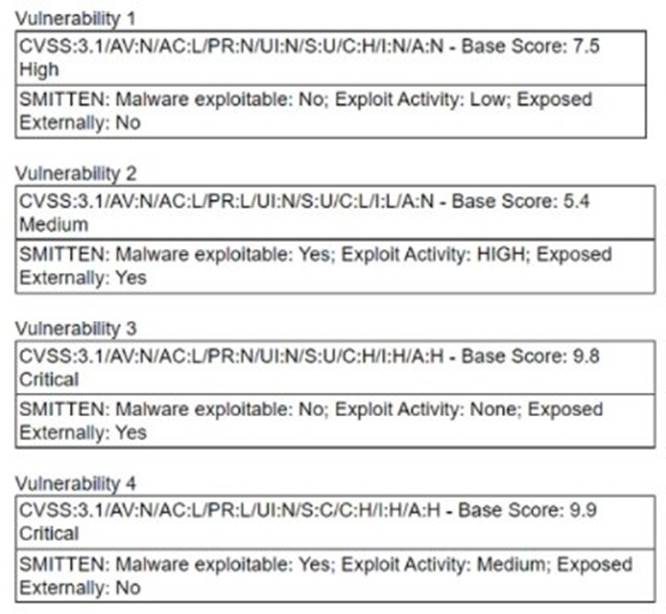
Which of the following vulnerabilities should be prioritized?
- A. Vulnerability 1
- B. Vulnerability 2
- C. Vulnerability 3
- D. Vulnerability 4
Answer: B
Explanation:
Vulnerability 2 should be prioritized as it is exploitable, has high exploit activity, and is exposed externally according to the SMITTEN metric. References: Vulnerability Management Metrics: 5 Metrics to Start Measuring in Your Program, Section: Vulnerability Severity.
NEW QUESTION 16
During a security test, a security analyst found a critical application with a buffer overflow vulnerability. Which of the following would be best to mitigate the vulnerability at the application level?
- A. Perform OS hardening.
- B. Implement input validation.
- C. Update third-party dependencies.
- D. Configure address space layout randomization.
Answer: B
Explanation:
Implementing input validation is the best way to mitigate the buffer overflow vulnerability at the application level. Input validation is a technique that checks the data entered by users or attackers against a set of rules or constraints, such as data type, length, format, or range. Input validation can prevent common web application attacks such as SQL injection, cross-site scripting (XSS), or command injection, which exploit the lack of input validation to execute malicious code or commands on the server or the client side. By validating the input before allowing submission, the web application can reject or sanitize any malicious or unexpected input, and protect the application from being compromised12. References: How to detect, prevent, and mitigate buffer overflow attacks - Synopsys, How to mitigate buffer overflow vulnerabilities | Infosec
NEW QUESTION 17
A security analyst is writing a shell script to identify IP addresses from the same country. Which of the following functions would help the analyst achieve the objective?
- A. function w() { info=$(ping -c 1 $1 | awk -F “/” ‘END{print $1}’) && echo “$1 | $info” }
- B. function x() { info=$(geoiplookup $1) && echo “$1 | $info” }
- C. function y() { info=$(dig -x $1 | grep PTR | tail -n 1 ) && echo “$1 | $info” }
- D. function z() { info=$(traceroute -m 40 $1 | awk ‘END{print $1}’) && echo “$1 | $info” }
Answer: B
Explanation:
The function that would help the analyst identify IP addresses from the same country is:
function x() { info=$(geoiplookup $1) && echo “$1 | $info” }
This function takes an IP address as an argument and uses the geoiplookup command to get the geographic location information associated with the IP address, such as the country name, country code, region, city, or latitude and longitude. The function then prints the IP address and the geographic location information, which can help identify any IP addresses that belong to the same country.
NEW QUESTION 18
An employee is no longer able to log in to an account after updating a browser. The employee usually has several tabs open in the browser. Which of
the following attacks was most likely performed?
- A. RFI
- B. LFI
- C. CSRF
- D. XSS
Answer: C
Explanation:
The most likely attack that was performed is CSRF (Cross-Site Request Forgery). This is an attack that forces a user to execute unwanted actions on a web application in which they are currently authenticated1. If the user has several tabs open in the browser, one of them might contain a malicious link or form that sends a request to the web application to change the user’s password, email address, or other account settings. The web application will not be able to distinguish between the legitimate requests made by the user and the forged requests made by the attacker. As a result, the user will lose access to their account.
To prevent CSRF attacks, web applications should implement some form of anti-CSRF tokens or other mechanisms that validate the origin and integrity of the requests2. These tokens are unique and unpredictable values that are generated by the server and embedded in the forms or URLs that perform state-changing actions. The server will then verify that the token received from the client matches the token stored on the server before processing the request. This way, an attacker cannot forge a valid request without knowing the token value.
Some other possible attacks that are not relevant to this scenario are:
✑ RFI (Remote File Inclusion) is an attack that allows an attacker to execute malicious code on a web server by including a remote file in a script. This attack does not affect the user’s browser or account settings.
✑ LFI (Local File Inclusion) is an attack that allows an attacker to read or execute local files on a web server by manipulating the input parameters of a script. This attack does not affect the user’s browser or account settings.
✑ XSS (Cross-Site Scripting) is an attack that injects malicious code into a web page that is then executed by the user’s browser. This attack can affect the user’s browser or account settings, but it requires the user to visit a compromised web page or click on a malicious link. It does not depend on having several tabs open in the browser.
NEW QUESTION 19
An organization conducted a web application vulnerability assessment against the corporate website, and the following output was observed: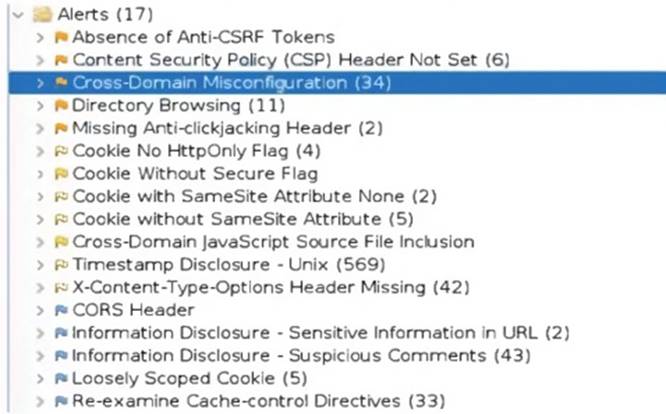
Which of the following tuning recommendations should the security analyst share?
- A. Set an HttpOnlvflaq to force communication by HTTPS
- B. Block requests without an X-Frame-Options header
- C. Configure an Access-Control-Allow-Origin header to authorized domains
- D. Disable the cross-origin resource sharing header
Answer: B
Explanation:
The output shows that the web application is vulnerable to clickjacking attacks, which allow an attacker to overlay a hidden frame on top of a legitimate page and trick users into clicking on malicious links. Blocking requests without an X-Frame-Options header can prevent this attack by instructing the browser to not display the page within a frame.
NEW QUESTION 20
......
Thanks for reading the newest CS0-003 exam dumps! We recommend you to try the PREMIUM Allfreedumps.com CS0-003 dumps in VCE and PDF here: https://www.allfreedumps.com/CS0-003-dumps.html (377 Q&As Dumps)