Our pass rate is high to 98.9% and the similarity percentage between our CV0-003 study guide and real exam is 90% based on our seven-year educating experience. Do you want achievements in the CompTIA CV0-003 exam in just one try? I am currently studying for the CompTIA CV0-003 exam. Latest CompTIA CV0-003 Test exam practice questions and answers, Try CompTIA CV0-003 Brain Dumps First.
Also have CV0-003 free dumps questions for you:
NEW QUESTION 1
A company wants to move to a multicloud environment and utilize the technology that provides the most portability. Which of the following technology solutions would BEST meet the company's needs?
- A. Bootstrap
- B. Virtual machines
- C. Clusters
- D. Containers
Answer: D
Explanation:
The technology that provides the most portability for a multicloud environment is containers. Containers are units of software that package an application and its dependencies into a standardized and isolated environment that can run on any platform or cloud service. Containers are lightweight, scalable, and portable, as they do not depend on the underlying infrastructure or operating system. Containers can also be managed by orchestration tools that automate the deployment, scaling, and networking of containerized applications across multiple clouds. Reference: [CompTIA Cloud+ Certification Exam Objectives], Domain 1.0 Configuration and Deployment, Objective 1.3 Given a scenario involving integration between multiple cloud environments, select an appropriate solution design.
NEW QUESTION 2
As a result of an IT audit, a customer has decided to move some applications from an old legacy system to a private cloud. The current server location is remote with low bandwidth. Which of the following is the best migration strategy to use for this deployment?
- A. P2V with physical data transport
- B. P2P with remote data copy
- C. V2V with physical data transport
- D. V2P with physical data transport
- E. V2P with remote data copy
Answer: A
Explanation:
P2V stands for physical to virtual, which is the process of converting a physical server into a virtual machine. This is a common migration strategy for moving legacy systems to the cloud, as it preserves the existing configuration and data of the server. Physical data transport means using a physical device, such as a hard disk drive or a USB flash drive, to transfer the data from the source location to the destination location. This method is suitable for remote locations with low bandwidth, as it avoids the network latency and congestion that may occur with remote data copy. P2P, V2V, and V2P are other types of migration strategies, but they are not applicable for this scenario. P2P stands for physical to physical, which is the process of moving a physical server to another physical server. V2V stands for virtual to virtual, which is the process of moving a virtual machine to another virtual machine. V2P stands for virtual to physical, which is the process of converting a virtual machine into a physical server. Remote data copy means using a network connection, such as FTP or SCP, to transfer the data from the source location to the destination location. This method is suitable for locations with high bandwidth and reliable network connectivity. References: CompTIA Cloud+ CV0-003 Certification Study Guide, Chapter 21, Cloud Migration, page 3371.
NEW QUESTION 3
SIMULATION
A company has decided to scale its e-commerce application from its corporate datacenter to a commercial cloud provider to meet an anticipated increase in demand during an upcoming holiday.
The majority of the application load takes place on the application server under normal conditions. For this reason, the company decides to deploy additional application servers into a commercial cloud provider using the on-premises orchestration engine that installs and configures common software and network configurations.
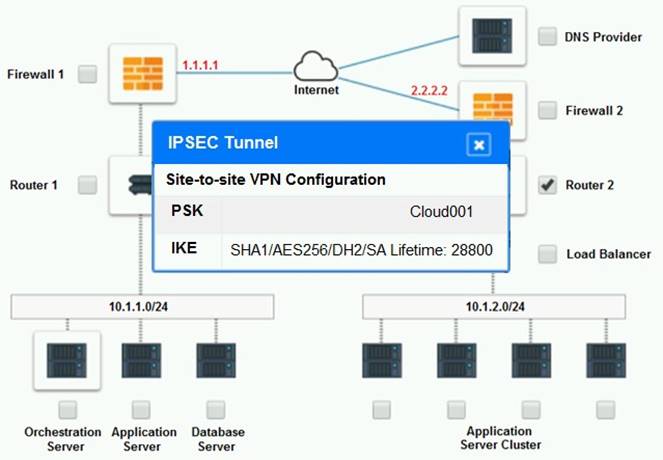
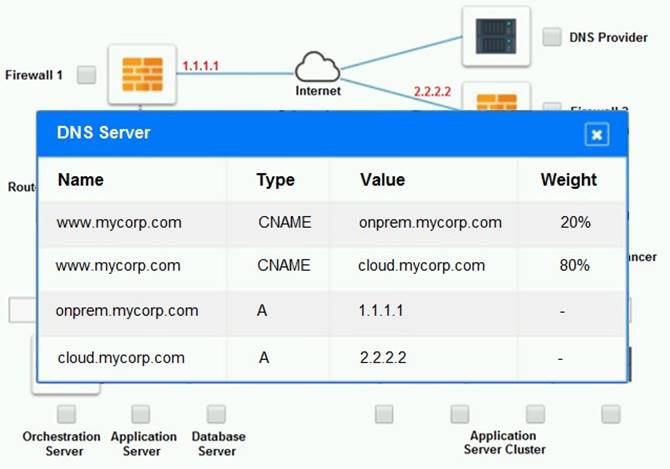
The remote computing environment is connected to the on-premises datacenter via a site- to-site IPSec tunnel. The external DNS provider has been configured to use weighted round-robin routing to load balance connections from the Internet.
During testing, the company discovers that only 20% of connections completed successfully.
INSTRUCTIONS
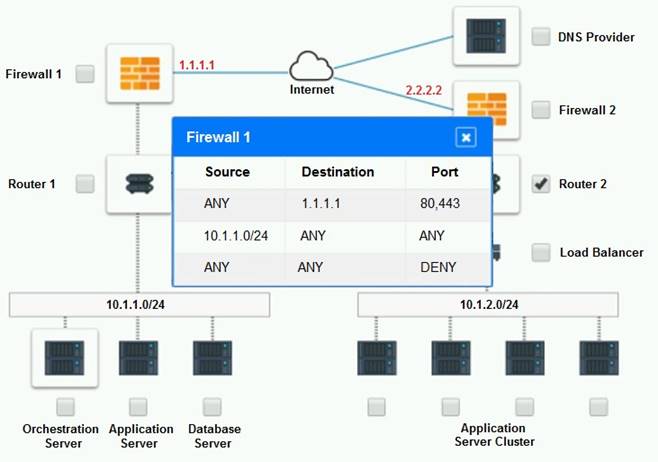
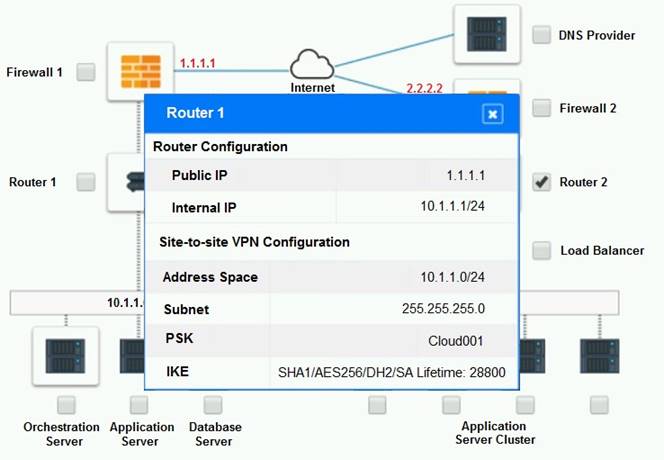
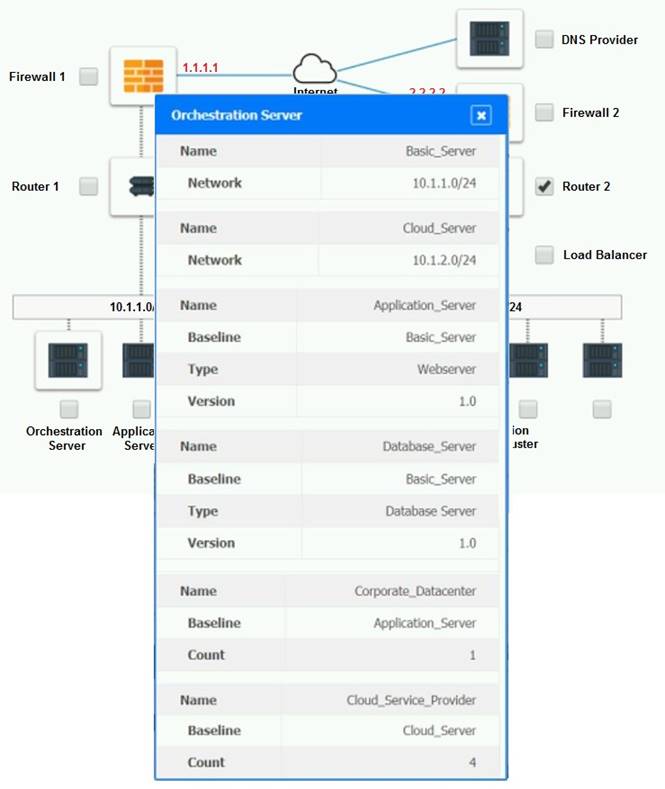
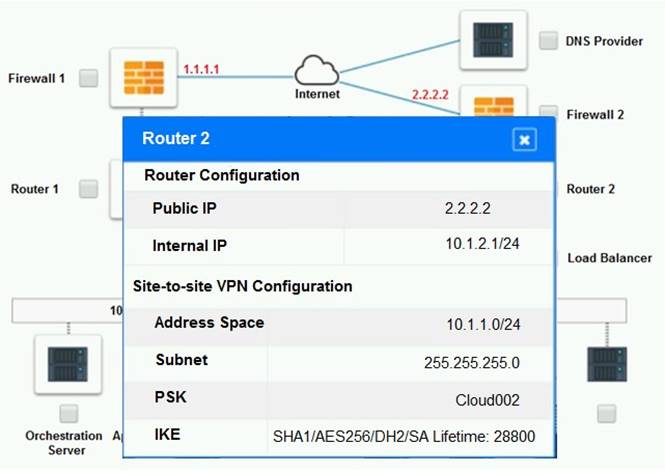
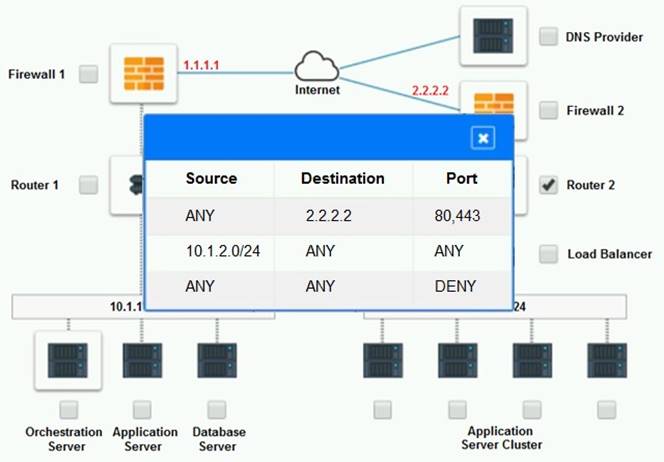
Review the network architecture and supporting documents and fulfill these requirements: Part 1: Analyze the configuration of the following components: DNS, Firewall 1, Firewall 2, Router 1, Router 2, VPN and Orchestrator Server.Identify the problematic device(s).
Part 2:Identify the correct options to provide adequate configuration for hybrid cloud architecture.
If at any time you would like to bring back the initial state of the simulation, please click the Reset All button.
Part 1:
Cloud Hybrid Network Diagram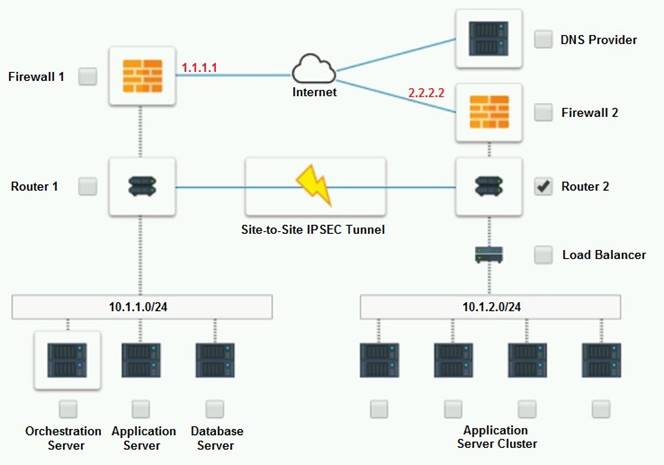
Part 2:
Only select a maximum of TWO options from the multiple choice question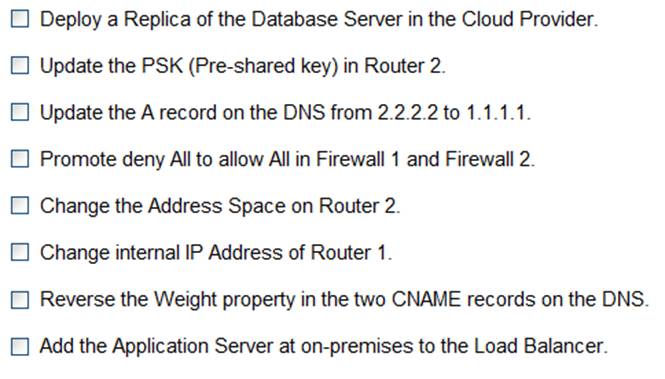
Solution:
Part 1: Router 2
The problematic device is Router 2, which has an incorrect configuration for the IPSec tunnel. The IPSec tunnel is a secure connection between the on-premises datacenter and the cloud provider, which allows the traffic to flow between the two networks. The IPSec tunnel requires both endpoints to have matching parameters, such as the IP addresses, the pre-shared key (PSK), the encryption and authentication algorithms, and the security associations (SAs) .
According to the network diagram and the configuration files, Router 2 has a different PSK and a different address space than Router 1. Router 2 has a PSK of “1234567890”, while Router 1 has a PSK of “0987654321”. Router 2 has an address space of 10.0.0.0/8, while Router 1 has an address space of 192.168.0.0/16. These mismatches prevent the IPSec tunnel from establishing and encrypting the traffic between the two networks.
The other devices do not have any obvious errors in their configuration. The DNS provider has two CNAME records that point to the application servers in the cloud provider, with different weights to balance the load. The firewall rules allow the traffic from and to the application servers on port 80 and port 443, as well as the traffic from and to the VPN server on port 500 and port 4500. The orchestration server has a script that installs and configures the application servers in the cloud provider, using the DHCP server to assign IP addresses.
Part 2:
The correct options to provide adequate configuration for hybrid cloud architecture are:
✑ Update the PSK in Router 2.
✑ Change the address space on Router 2.
These options will fix the IPSec tunnel configuration and allow the traffic to flow between the on-premises datacenter and the cloud provider. The PSK should match the one on Router 1, which is “0987654321”. The address space should also match the one on Router 1, which is 192.168.0.0/16.
* B. Update the PSK (Pre-shared key in Router2)
* E. Change the Address Space on Router2
Does this meet the goal?
- A. Yes
- B. Not Mastered
Answer: A
NEW QUESTION 4
A cloud solutions architect has received guidance to migrate an application from on premises to a public cloud. Which of the following requirements will help predict the operational expenditures in the cloud?
- A. Average resource consumption
- B. Maximum resource consumption
- C. Minimum resource consumption
- D. Actual hardware configuration
Answer: B
Explanation:
Maximum resource consumption is what will help predict the operational expenditures in the cloud for an application that is being migrated from on premises to a public cloud provider. Operational expenditures are the ongoing costs of running and maintaining a system or service, such as cloud resources or services. Operational expenditures can vary depending on various factors, such as usage, demand, performance, etc. Maximum resource consumption is the highest amount of resources or capacity that are used or consumed by a system or service during peak periods of activity or load. Maximum resource consumption can help predict operational expenditures in the cloud by providing information such as:
✑ Resource type: This indicates what type of resources are used or consumed by the system or service, such as compute, storage, network, etc.
✑ Resource amount: This indicates how much of each resource type are used or consumed by the system or service, such as CPU cores, memory, disk space, bandwidth, etc.
✑ Resource price: This indicates how much each resource type costs in the cloud provider’s pricing model, such as per hour, per GB, per Mbps, etc.
NEW QUESTION 5
An organization is implementing a new requirement to facilitate faster downloads for users of corporate application content. At the same time, the organization is also expanding cloud regions. Which of the following would be suitable to optimize the network for this requirement?
- A. Implement CDN for overall cloud application.
- B. Implement autoscaling of the compute resources.
- C. Implement SR-IOV on the server instances.
- D. Implement an application container solution.
Answer: A
Explanation:
CDN, or content delivery network, is a system of distributed servers that deliver web content to users based on their geographic location, the origin of the web page, and the content delivery server1. A CDN can improve the performance, availability, and scalability of cloud applications by caching static and dynamic content at the edge of the network, reducing the latency and bandwidth consumption between the users and the cloud servers2. A CDN can also provide security features such as encryption, authentication, and DDoS protection3.
Autoscaling, SR-IOV, and containerization are other techniques that can optimize the network for cloud applications, but they are not directly related to the requirement of faster downloads for users. Autoscaling is the process of automatically adjusting the number and size of compute resources based on the demand and workload of the application. SR-IOV, or single root I/O virtualization, is a technology that allows a physical network device to be partitioned into multiple virtual devices that can be assigned to different virtual machines or containers, bypassing the hypervisor and improving the network performance and efficiency. Containerization is the process of packaging an application and its dependencies into a lightweight and portable unit that can run on any platform, providing isolation, consistency, and portability.
References:
✑ CompTIA Cloud+ CV0-003 Study Guide, Chapter 4: Network Optimization, Section 4.1: Content Delivery Networks, Page 17523
✑ CompTIA Cloud+ CV0-003 Study Guide, Chapter 4: Network Optimization, Section 4.2: Autoscaling, Page 180
✑ CompTIA Cloud+ CV0-003 Study Guide, Chapter 4: Network Optimization, Section 4.3: SR-IOV, Page 184
✑ CompTIA Cloud+ CV0-003 Study Guide, Chapter 4: Network Optimization, Section 4.4: Containerization, Page 187
✑ What is a CDN?
NEW QUESTION 6
A cloud administrator is responsible for managing a cloud-based content management solution. According to the security policy, any data that is hosted in the cloud must be protected against data exfiltration. Which of the following solutions should the administrator implement?
- A. HIDS
- B. FIM
- C. DLP
- D. WAF
Answer: C
Explanation:
DLP (Data Loss Prevention) is what the administrator should implement to protect data against data exfiltration in a cloud-based content management solution. Data exfiltration is a process of transferring or stealing data from a system or network without authorization or permission. Data exfiltration can cause data breaches, leaks, or losses that may affect confidentiality, integrity, or availability of data. DLP is a tool or service that monitors and controls data movement and usage within a system or network. DLP can help to prevent data exfiltration by detecting and blocking any unauthorized or suspicious data
transfers or activities, as well as enforcing policies and rules for data classification, encryption, access, etc.
NEW QUESTION 7
A cloud administrator is supporting an application that has several reliability issues. The administrator needs visibility into the performance characteristics of the application. Which of the following will MOST likely be used in a reporting dashboard?
- A. Data from files containing error messages from the application
- B. Results from the last performance and workload testing
- C. Detail log data from syslog files of the application
- D. Metrics and time-series data measuring key performance indicators
Answer: D
Explanation:
The best answer is D. Metrics and time-series data measuring key performance indicators.
Metrics and time-series data are numerical values that represent the state and behavior of a system over time. They can measure key performance indicators (KPIs) such as availability, latency, throughput, error rate, and resource utilization. Metrics and time-series data can help a cloud administrator to monitor, analyze, and troubleshoot the performance characteristics of an application .
Metrics and time-series data are most likely to be used in a reporting dashboard, because they can provide a clear and concise overview of the application’s performance. A reporting dashboard is a graphical user interface that displays the most important information about a system or a process in a single view. A reporting dashboard can help a cloud administrator to:
Visualize the trends and patterns of the metrics and time-series data using charts, graphs, tables, or gauges .
Compare the actual performance of the application with the expected or desired performance based on the defined service level objectives (SLOs) or service level agreements (SLAs) .
Identify and diagnose any performance issues or anomalies that may affect the reliability of the application .
Communicate and report the performance status and results to the stakeholders or customers.
The other options are not as likely to be used in a reporting dashboard, because they are either too detailed, too outdated, or too irrelevant for measuring the performance characteristics of the application. For example:
Data from files containing error messages from the application (A) may help to identify and debug some specific errors or exceptions that occur in the application. However, they are not sufficient to measure the overall performance or reliability of the application. They are also too verbose and unstructured to be displayed in a reporting dashboard.
Results from the last performance and workload testing (B) may help to evaluate and optimize the performance of the application under different scenarios and conditions. However, they are not representative of the current or real-time performance of the application in production. They are also too static and outdated to be displayed in a reporting dashboard.
Detail log data from syslog files of the application © may help to record and track the events and activities that happen in the application. However, they are not designed to measure the key performance indicators or metrics of the application. They are also too complex and voluminous to be displayed in a reporting dashboard.
NEW QUESTION 8
A company that performs passive vulnerability scanning at its transit VPC has detected a vulnerability related to outdated web-server software on one of its public subnets. Which of the following can the use to verify if this is a true positive with the LEAST effort and cost? (Select TWO).
- A. A network-based scan
- B. An agent-based scan
- C. A port scan
- D. A red-team exercise
- E. A credentialed scan
- F. A blue-team exercise
- G. Unknown environment penetration testing
Answer: BE
Explanation:
The correct answer is B and E. An agent-based scan and a credentialed scan can help verify if the vulnerability related to outdated web-server software is a true positive with the least effort and cost.
An agent-based scan is a type of vulnerability scan that uses software agents installed on the target systems to collect and report data on vulnerabilities. This method can provide more accurate and detailed results than a network-based scan, which relies on network traffic analysis and probes1. An agent-based scan can also reduce the network bandwidth and performance impact of scanning, as well as avoid triggering false alarms from intrusion detection systems2.
A credentialed scan is a type of vulnerability scan that uses valid login credentials to access the target systems and perform a more thorough and comprehensive assessment of their configuration, patch level, and vulnerabilities. A credentialed scan can identify vulnerabilities that are not visible or exploitable from the network level, such as missing updates, weak passwords, or misconfigured services3. A credentialed scan can also reduce the risk of false positives and false negatives, as well as avoid causing damage or disruption to the target systems3.
A network-based scan, a port scan, a red-team exercise, a blue-team exercise, and unknown environment penetration testing are not the best options to verify if the vulnerability is a true positive with the least effort and cost. A network-based scan and a port scan may not be able to detect the vulnerability if it is not exposed or exploitable from the network level. A red-team exercise, a blue-team exercise, and unknown environment penetration testing are more complex, time-consuming, and costly methods that involve simulating real-world attacks or defending against them. These methods are more suitable for testing the overall security posture and resilience of an organization, rather than verifying a specific vulnerability4.
NEW QUESTION 9
A cloud engineer is responsible for managing two cloud environments from different MSPs. The security department would like to inspect all traffic from the two cloud environments.
Which of the following network topology solutions should the cloud engineer implement to reduce long-term maintenance?
- A. Chain
- B. Star
- C. Mesh
- D. Hub and spoke
Answer: D
Explanation:
Hub and spoke is a type of network topology that consists of a central node or device (hub) that connects to multiple peripheral nodes or devices (spokes). Hub and spoke can help reduce long-term maintenance for managing two cloud environments from different MSPs, as it can simplify and centralize the network configuration and management by using the hub as a single point of contact and control for the spokes. Hub and spoke can also improve network performance and security, as it can reduce latency, bandwidth consumption, and network congestion by routing traffic through the hub. References: CompTIA Cloud+ Certification Exam Objectives, page 15, section 2.8
NEW QUESTION 10
A systems administrator is selecting the appropriate RAID level to support a private cloud with the following requirements:
. The storage array must withstand the failure of up to two drives.
. The storage array must maximize the storage capacity of its drives.
Which of the following RAID levels should the administrator implement?
- A. RAID 0
- B. RAID 1
- C. RAID 5
- D. RAID 6
- E. RAID 10
Answer: D
Explanation:
RAID stands for Redundant Array of Independent Disks, which is a technology that combines multiple physical disks into a logical unit that provides improved performance, reliability, and storage capacity. RAID levels are different ways of organizing and distributing data across the disks in a RAID array. Each RAID level has its own advantages and disadvantages, depending on the requirements and trade-offs of the system.
RAID 6 is a RAID level that uses block-level striping with double parity. This means that data is divided into blocks and distributed across all the disks in the array, and two sets of parity information are calculated and stored on different disks. Parity is a method of error detection and correction that can reconstruct the data in case of disk failure. RAID 6 can withstand the failure of up to two disks without losing any data, which makes it suitable for a private cloud that requires high fault tolerance. RAID 6 also maximizes the storage capacity of its drives, as it only uses two disks for parity and the rest for data. The storage capacity of a RAID 6 array is equal to (n-2) x S, where n is the number of disks and S is the size of the smallest disk.
RAID 0, RAID 1, RAID 5, and RAID 10 are other RAID levels, but they do not meet the requirements of the private cloud. RAID 0 uses striping without parity, which improves performance but does not provide any redundancy or fault tolerance. RAID 0 cannot withstand any disk failure, as it would result in data loss. RAID 1 uses mirroring, which copies the same data to two or more disks. RAID 1 provides high reliability and fast read performance, but it wastes half of the storage capacity for redundancy. RAID 1 can only withstand the failure of one disk in each mirrored pair. RAID 5 uses striping with single parity, which distributes data and parity across all the disks in the array. RAID 5 provides a balance of performance, reliability, and storage capacity, but it can only withstand the failure of one disk. RAID 10 is a combination of RAID 1 and RAID 0, which creates a striped array of mirrored pairs. RAID 10 provides high performance and reliability, but it also wastes half of the storage capacity for redundancy. RAID 10 can withstand the failure of one disk in each mirrored pair, but not more than that.
For more information on RAID levels, you can refer to the following sources:
✑ CompTIA Cloud+ CV0-003 Certification Study Guide, Chapter 4, Storage Technologies, page 791
✑ Cloud+ (Plus) Certification | CompTIA IT Certifications2
NEW QUESTION 11
After an infrastructure-as-code cloud migration to an laaS environment, the cloud engineer discovers that configurations on DB servers have drifted from the corporate standard baselines. Which of the following should the cloud engineer do to best ensure configurations are restored to the baselines?
- A. Utilize a template to automate and update the DB configuration.
- B. Create an image of the DB, delete the previous DB server, and restore from the image.
- C. Manually log in to the DB servers and update the configurations.
- D. Rename and change the IP of the old DB server and rebuild a new DB server.
Answer: A
Explanation:
A template is a file that defines the desired state and configuration of a cloud resource, such as a server, a network, or a database. Infrastructure as code (IaC) is the practice of using templates to automate and manage cloud resources, rather than manually configuring them. IaC can help prevent configuration drift, which is the deviation of the actual state of a resource from the desired state defined by the template. In this scenario, the cloud engineer discovers that configurations on DB servers have drifted from the corporate standard baselines after an IaC cloud migration to an IaaS environment. The best way to ensure configurations are restored to the baselines is to utilize a template to automate and update the DB configuration. This way, the cloud engineer can apply the same template to all the DB servers, and ensure they are consistent and compliant with the corporate standards. Creating an image of the DB, deleting the previous DB server, and restoring from the image is not a good solution, as it may cause data loss, downtime, and additional costs. Manually logging in to the DB servers and updating the configurations is not a good solution, as it is time-consuming, error-prone, and not scalable. Renaming and
changing the IP of the old DB server and rebuilding a new DB server is not a good solution, as it may cause compatibility issues, network disruptions, and security
risks. References: CompTIA Cloud+ CV0-003 Certification Study Guide, Chapter 23, Infrastructure as Code and Configuration Management, page 3691.
NEW QUESTION 12
A cloud architect is designing the VPCs for a new hybrid cloud deployment. The business requires the following:
✑ High availability
✑ Horizontal auto-scaling
✑ 60 nodes peak capacity per region
✑ Five reserved network IP addresses per subnet
✑ /24 range
Which of the following would BEST meet the above requirements?
- A. Create two /25 subnets in different regions
- B. Create three /25 subnets in different regions
- C. Create two /26 subnets in different regions
- D. Create three /26 subnets in different regions
- E. Create two /27 subnets in different regions
- F. Create three /27 subnets in different regions
Answer: C
Explanation:
A /26 subnet is a subnet that has a network prefix of 26 bits and a host prefix of 6 bits. A /26 subnet can support up to 64 hosts (62 usable hosts) and has a subnet mask of 255.255.255.192. Creating two /26 subnets in different regions can best meet the business requirements for deploying a high availability, horizontally auto-scaling solution that has a peak capacity of 60 nodes per region and five reserved network IP addresses per subnet. Creating two /26 subnets can provide enough host addresses for the peak capacity and the reserved addresses, as well as allow for some growth or redundancy. Creating the subnets in different regions can provide high availability and horizontal auto- scaling, as it can distribute the workload across multiple locations and scale out or in based on demand. References: CompTIA Cloud+ Certification Exam Objectives, page 15, section 2.8
NEW QUESTION 13
To save on licensing costs, the on-premises, IaaS-hosted databases need to be migrated to a public DBaaS solution. Which of the following would be the BEST technique?
- A. Live migration
- B. Physical-to-virtual
- C. Storage-level mirroring
- D. Database replication
Answer: D
Explanation:
Database replication is the best technique to migrate databases from an on- premises IaaS-hosted environment to a public DBaaS solution. Database replication is a process of copying data from one database server to another database server in real-time or near real-time. Database replication can ensure data consistency and availability across different locations and platforms. Database replication can facilitate migration by synchronizing data between on-premises databases and cloud databases.
NEW QUESTION 14
A systems administrator wants to have near-real-time information on the volume of data being exchanged between an application server and its clients on the Internet.
Which of the following should the systems administrator implement to achieve this objective?
- A. A stateful firewall
- B. DLP
- C. DNSSEC
- D. Network flows
Answer: D
Explanation:
Network flows are records of network traffic that capture information such as source and destination IP addresses, ports, protocols, timestamps, and byte and packet counts. Network flows can provide near-real-time information on the volume of data being exchanged between a system and its clients on the Internet, as they can measure and monitor the amount and rate of network traffic for each connection or session. Network flows can also help analyze network performance, troubleshoot network issues, and detect network anomalies or security incidents. A systems administrator should implement network flows to achieve the objective of having near-real-time information on the volume
of data being exchanged between an application server and its clients on the Internet. References: CompTIA Cloud+ Certification Exam Objectives, page 16, section 3.2
NEW QUESTION 15
A systems administrator is performing upgrades to all the hypervisors in the environment. Which of the following components of the hypervisors should be upgraded? (Choose two.)
- A. The fabric interconnects
- B. The virtual appliances
- C. The firmware
- D. The virtual machines
- E. The baselines
- F. The operating system
Answer: CF
Explanation:
These are the components of the hypervisors that should be upgraded by the administrator who is performing upgrades to all the hypervisors in the environment. A hypervisor is a software or hardware that allows multiple VMs (Virtual Machines) to run on a single physical host or server. A hypervisor consists of various components, such as:
✑ The firmware: This is the software that controls the basic functions and operations of the hardware or device. The firmware can affect the performance, compatibility, and security of the hypervisor and the VMs. The firmware should be upgraded to ensure that it supports the latest features and functions of the hardware or device, as well as fix any bugs or vulnerabilities.
✑ The operating system: This is the software that manages the resources and activities of the hypervisor and the VMs. The operating system can affect the functionality, reliability, and efficiency of the hypervisor and the VMs. The operating system should be upgraded to ensure that it supports the latest applications and services of the hypervisor and the VMs, as well as improve stability and performance.
NEW QUESTION 16
A systems administrator swapped a failed hard drive on a server with a RAID 5 array. During the RAID resynchronization, a second hard drive failed.
Which of the following actions will make the server fully operational?
- A. Restart the RAID resynchronization process
- B. Perform a P2V migration of the server
- C. Swap the failed hard drive with a fresh one
- D. Restore the server from backup
Answer: D
Explanation:
RAID 5 is a disk array configuration that uses parity to provide fault tolerance and data recovery. RAID 5 can tolerate the failure of one disk, but not two or more disks. If a second disk fails during the resynchronization process, the data on the RAID 5 array will be lost and unrecoverable. The only way to make the server fully operational is to restore the data from a backup source.
NEW QUESTION 17
A cloud engineer recently used a deployment script template to implement changes on a cloud-hosted web application. The web application communicates with a managed database on the back end. The engineer later notices the web application is no longer receiving data from the managed database. Which of the following is the most likely cause of the issue?
- A. Misconfiguration in the user permissions
- B. Misconfiguration in the routing traffic
- C. Misconfiguration in the network ACL
- D. Misconfiguration in the firewall
Answer: D
Explanation:
A misconfiguration in the firewall can block the communication between the web application and the managed database, preventing the web application from receiving data. A firewall is a network security device that monitors and controls incoming and outgoing network traffic based on predefined rules1. A deployment script template is a way to automate the deployment of resources and configurations in Azure Resource Manager1. If the script template contains incorrect or conflicting rules for the firewall, it can cause the issue.
References: CompTIA Cloud+ CV0-003 Exam Objectives, Objective 2.2: Given a scenario, deploy and test a cloud solution ; Use deployment scripts in templates - Azure Resource Manager1
NEW QUESTION 18
A web application has been configured to use autoscaling for provisioning and deprovisioning more VMs according to the workload. The systems administrator deployed a new CI/CD tool to automate new releases of the web application. During the night, a script was deployed and configured to be executed by the VMs during bootstrapping. Now. the autoscaling configuration is creating a new VM ever\ five minutes. Which of the following actions will MOS I like y resolve the issue?
- A. Reducing the maximum threshold in the autoscaling configuration
- B. Debugging the script and redeploying it
- C. Changing the automation tool because it is incompatible
- D. Modifying the script to shut down the VM after five minutes
Answer: B
Explanation:
The best way to resolve the issue where the autoscaling configuration is creating a new VM every five minutes after deploying a new CI/CD tool to automate new releases of the web application and configuring a script to be executed by the VMs during bootstrapping is to debug the script and redeploy it. Debugging the script means finding and fixing any errors or bugs in the code or logic of the script that may cause unexpected or undesired behavior, such as triggering the autoscaling condition or failing to complete the bootstrapping process. Redeploying the script means updating or replacing the existing script with the corrected or improved version of the script. Reference: [CompTIA Cloud+ Certification Exam Objectives], Domain 4.0 Troubleshooting, Objective 4.5 Given a scenario, troubleshoot automation/orchestration issues.
NEW QUESTION 19
......
P.S. 2passeasy now are offering 100% pass ensure CV0-003 dumps! All CV0-003 exam questions have been updated with correct answers: https://www.2passeasy.com/dumps/CV0-003/ (456 New Questions)