Passleader CV0-003 Questions are updated and all CV0-003 answers are verified by experts. Once you have completely prepared with our CV0-003 exam prep kits you will be ready for the real CV0-003 exam without a problem. We have Up to the immediate present CompTIA CV0-003 dumps study guide. PASSED CV0-003 First attempt! Here What I Did.
Online CompTIA CV0-003 free dumps demo Below:
NEW QUESTION 1
A cloud engineer is responsible for a legacy web application that runs on an on-premises VM environment. The VM environment is approaching end of life. The engineer needs to migrate the web application to the cloud as quickly as possible because the VM environment has the following limitations:
• The VM environment has a single IOGB disk.
• The VM environment still uses 10Mbps, which leaves a 100Mbps WAN connection underutilized.
• No installation media is available.
Which of the following is the best way to migrate the web application to the cloud?
- A. Use the VM import connector to import the VM into the cloud.
- B. Use import/export to import the VM as a snapshot and attach it to a cloud instance.
- C. Use REST APIs to import an image of the VM into the cloud.
- D. Use object storage to create a backup of the VM and restore data into the cloud instance.
Answer: A
Explanation:
A VM import connector is a tool that allows you to import virtual machines from your on-premises environment into the cloud using a graphical user interface. This is the fastest and easiest way to migrate a legacy web application without requiring installation media or changing the configuration of the VM. The VM import connector can also handle the disk size and network bandwidth limitations of the on-premises VM environment. References: EC2 VM Import Connector | AWS News Blog, Import a VMware Virtual Machine to Oracle Cloud Infrastructure, CompTIA Cloud+ Certification Exam Objectives, Domain 2.0: Deployment, Objective 2.1: Given a scenario, execute and implement solutions using appropriate cloud migration tools and methods.
NEW QUESTION 2
A systems administrator is responding to an outage in a cloud environment that was caused by a network-based flooding attack. Which of the following should the administrator configure to mitigate the attack?
- A. NIPS
- B. Network overlay using GENEVE
- C. DDoS protection
- D. DoH
Answer: C
Explanation:
DDoS protection is what the administrator should configure to mitigate a network-based flooding attack that caused an outage in a cloud environment. A network- based flooding attack is a type of attack that sends a large amount of network traffic or requests to a target system or service, such as a server, website, application, etc., with the intention of overwhelming or exhausting its resources or capacity. A network-based flooding attack can cause an outage in a cloud environment by disrupting or degrading the availability or performance of the target system or service, as well as affecting other systems or services that share the same network or infrastructure. DDoS protection is a tool or service that detects and prevents network-based flooding attacks, also known as Distributed Denial of Service (DDoS) attacks. DDoS protection can mitigate a network- based flooding attack by providing features such as:
✑ Filtering: DDoS protection can filter network traffic or requests based on various criteria, such as source, destination, protocol, content, etc., and block or allow them accordingly.
✑ Diverting: DDoS protection can divert network traffic or requests away from the target system or service to another location or device, such as a scrubbing center, proxy, firewall, etc., where they can be analyzed and processed.
✑ Scaling: DDoS protection can scale network resources or capacity dynamically and automatically to handle the increased demand or load caused by the network- based flooding attack.
NEW QUESTION 3
A cloud administrator is choosing a backup schedule for a new application platform that creates many small files. The backup process impacts the performance of the application, and backup times should be minimized during weekdays. Which of the following backup types best meets the weekday requirements?
- A. Database dump
- B. Differential
- C. Incremental
- D. Full
Answer: C
Explanation:
Incremental backups only back up the files that have changed since the last backup, which minimizes the backup time and the performance impact on the application. Differential backups back up all the files that have changed since the last full backup, which can take longer and consume more storage space. Database dump and full backups are not suitable for weekday requirements, as they back up the entire database or filesystem, which can be time-consuming and resource-intensive.
References: CompTIA Cloud+ CV0-003 Exam Objectives, Objective 3.3: Given a scenario, implement backup, restore, disaster recovery and business continuity solutions
NEW QUESTION 4
An integration application that communicates between different application and database servers is currently hosted on a physical machine. A P2V migration needs to be done to reduce the hardware footprint. Which of the following should be considered to maintain the same level of network throughput and latency in the virtual server?
- A. Upgrading the physical server NICs to support 10Gbps
- B. Adding more vCPU
- C. Enabling SR-IOV capability
- D. Increasing the VM swap/paging size
Answer: C
Explanation:
SR-IOV stands for Single Root I/O Virtualization, which is a technology that allows a physical network adapter to be partitioned into multiple virtual functions (VFs) that can be directly assigned to virtual machines (VMs). This way, the network traffic bypasses the software layer of the hypervisor and the virtual switch, and goes directly from the VM to the physical adapter. This reduces the CPU overhead, the network latency, and the packet loss, and improves the network throughput and scalability. SR-IOV can achieve near-native performance for network-intensive applications, such as an integration application that communicates between different application and database servers. By enabling SR-IOV capability on the physical server and the virtual server, the P2V migration can maintain the same level of network throughput and latency as the original physical machine. References: High performance network virtualization with SR-IOV; Supercharge Your Network Throughput via Single Root I/O Virtualization (SR-IOV); Overview of Single Root I/O Virtualization (SR-IOV).
NEW QUESTION 5
A cloud administrator is reviewing the annual contracts for all hosted solutions. Upon review of the contract for the hosted mail solution, the administrator notes the monthly subscription rate has increased every year. The provider has been in place for ten years, and there is a large amount of data being hosted. Which of the following is a barrier to switching providers?
- A. Service_level agreement
- B. Vendor lock-in
- C. Memorandum of understanding
- D. Encrypted data
Answer: B
Explanation:
The correct answer is B. Vendor lock-in. Vendor lock-in is a situation where a customer becomes dependent on a certain cloud provider and cannot easily switch to another provider without significant costs or disruptions. This can happen when the customer uses features or services that are only available from that specific provider, or when the customer has a large amount of data stored with the provider that is difficult to migrate. According to the web search results, vendor lock-in is a common concern in cloud computing1234. A service level agreement, a memorandum of understanding, and encrypted data are not barriers to switching providers, as they do not create a dependency on a specific provider or make it difficult to move data. For more information on vendor lock-in and how to avoid it, you can refer to the Cloudflare website1 or the Seagate blog4.
NEW QUESTION 6
A corporation is evaluating an offer from a CSP to take advantage of volume discounts on a shared platform. The finance department is concerned about cost allocation transparency, as the current structure splits projects into dedicated billing accounts. Which of the following can be used to address this concern?
- A. Implementing resource tagging
- B. Defining a cost baseline
- C. Consolidating the billing accounts
- D. Using a third-party accounting tool
Answer: A
Explanation:
Resource tagging is a process of adding descriptive metadata (tags) to cloud resources, such as virtual machines, storage accounts, databases, etc. Tags can be used to track and allocate costs, identify resources by project, owner, environment, or any other criteria. Resource tagging can help the finance department to have cost allocation transparency across different projects on a shared platform. References: CompTIA Cloud+ Certification Exam Objectives, Domain 4.0: Operations and Support, Objective 4.3: Given a scenario, apply the appropriate methods for cost control in a cloud environment. Cloud Resource Tagging | Cloud Foundation Community, Define your tagging strategy - Cloud Adoption Framework
NEW QUESTION 7
A company has a web application running in an on-premises environment that needs to be migrated to the cloud. The company wants to implement a solution that maximizes scalability, availability, and security, while requiring no infrastructure administration. Which of the following services would be BEST to meet this goal?
- A. A PaaS solution
- B. A hybrid solution
- C. An laaS solution
- D. A SaaS solution
Answer: A
Explanation:
A PaaS solution, or platform as a service, is a cloud computing service that provides a complete, ready-to-use, cloud-hosted platform for developing, running, maintaining and managing applications1. A PaaS solution would meet the company’s goal of maximizing scalability, availability, and security, while requiring no infrastructure administration, because:
Scalability: A PaaS solution can automatically scale up or down the resources needed to run the application based on the demand and traffic. The company does not need to worry about provisioning or managing servers, storage, network, or load balancers23.
Availability: A PaaS solution can ensure high availability and reliability of the application by replicating it across multiple regions and zones. The company does not need to worry about backup, recovery, or failover23.
Security: A PaaS solution can provide built-in security features such as encryption, authentication, authorization, and firewall. The company does not need to worry about installing or updating security patches or software23.
No infrastructure administration: A PaaS solution can abstract away the underlying infrastructure and hardware from the company. The company only needs to focus on developing and deploying the application code and data. The PaaS provider takes care of the rest23.
A hybrid solution (B) is a cloud computing service that combines on-premises and cloud resources. It may offer some benefits such as flexibility and cost optimization, but it would not meet the company’s goal of requiring no infrastructure administration. The company would still need to manage and maintain the on-premises part of the solution4.
An IaaS solution ©, or infrastructure as a service, is a
NEW QUESTION 8
A company recently subscribed to a SaaS collaboration service for its business users. The company also has an on-premises collaboration solution and would like users to have a seamless experience regardless of the collaboration solution being used.
Which of the following should the administrator implement?
- A. LDAP
- B. WAF
- C. VDI
- D. SSO
Answer: D
Explanation:
Single sign-on (SSO) is a type of authentication mechanism that allows users to access multiple systems or applications with a single login credential. SSO can help users have a seamless experience regardless of the collaboration solution being used, as it can eliminate the need for multiple logins and passwords for different systems or applications. SSO can also improve user convenience, productivity, and security, as it can simplify the login process, reduce login errors, and enhance password management. References: CompTIA Cloud+ Certification Exam Objectives, page 14, section 2.7
NEW QUESTION 9
An IaaS application has a two-hour RTO and a four-hour RPO. The application takes one hour to back up its data or restore from a local backup file. A systems administrator is tasked with configuring the backup policy.
Which of the following should the administrator configure to achieve the application requirements with the LEAST cost?
- A. Back up to long-term storage every night
- B. Back up to object storage every three hours
- C. Back up to long-term storage every four hours
- D. Back up to object storage every hour
Answer: B
Explanation:
Object storage is a type of storage service that stores data as objects with unique identifiers and metadata in a flat namespace or structure. Backing up to object storage every three hours can help achieve the application requirements with the least cost for an IaaS application that has a two-hour RTO and a four-hour RPO, as it can provide scalable, durable, and cost-effective storage for backup data while meeting the recovery time and point objectives. Backing up to object storage every three hours can ensure that the backup data is no more than four hours old and can be restored within two hours in case of a disaster or failure. References: CompTIA Cloud+ Certification Exam Objectives, page 9, section 1.4
NEW QUESTION 10
A software development manager is looking for a solution that will allow a team of developers to work in isolated environments that can be spun up and torn down quickly.
Which of the following is the MOST appropriate solution?
- A. Containers
- B. File subscriptions
- C. Ballooning
- D. Software-defined storage
Answer: A
Explanation:
Containers are isolated environments that can run applications and their dependencies without interfering with other processes or systems. Containers are lightweight, portable, and scalable, which makes them ideal for development and testing purposes. Containers can be spun up and torn down quickly using tools such as Docker, Kubernetes, etc.
NEW QUESTION 11
Which of the following actions should a systems administrator perform during the containment phase of a security incident in the cloud?
- A. Deploy a new instance using a known-good base image.
- B. Configure a firewall rule to block the traffic on the affected instance.
- C. Perform a forensic analysis of the affected instance.
- D. Conduct a tabletop exercise involving developers and systems administrators.
Answer: B
Explanation:
Configuring a firewall rule to block the traffic on the affected instance is what the administrator should perform during the containment phase of a security incident in the cloud. A security incident is an event or situation that affects or may affect the confidentiality, integrity, or availability of cloud resources or data. A security incident response is a process of managing and resolving a security incident using various phases, such as identification, containment, eradication, recovery, etc. The containment phase is where the administrator tries to isolate and prevent the spread or escalation of the security
incident. Configuring a firewall rule to block the traffic on the affected instance can help to contain a security incident by cutting off any communication or interaction between the instance and other systems or networks, which may stop any malicious or unauthorized activity or access.
NEW QUESTION 12
A systems administrator is asked to implement a new three-host cluster. The cloud architect specifies this should be a testing environment, and the budget is limited. The estimated resource consumption for each application is as follows: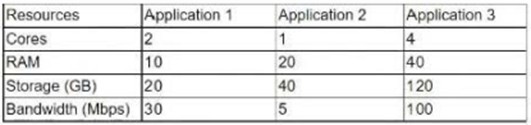
- A. • Three public cloud hosts with four cores• 120GB of RAM• 100GB of storage• 1Gbps
- B. • Three public cloud hosts with six cores• 80GB of RAM• 180GB of storage• 150Mbps
- C. • Three public cloud hosts with six cores• 80GB of RAM• 1TB of storage• 200Mbps
- D. • Four public cloud hosts with four cores• 140GB of RAM• 200GB of storage
Answer: B
Explanation:
The best option to implement a new three-host cluster with a limited budget for testing purposes is to use three public cloud hosts with six cores, 80GB of RAM, 180GB of storage, and 150Mbps of bandwidth each. This option will provide enough resources to run all the applications without exceeding their estimated consumption, while also minimizing the cost and complexity of the cluster. The other options either provide insufficient or excessive resources, which could affect the performance or cost of the cluster. Reference: [CompTIA Cloud+ Certification Exam Objectives], Domain 1.0 Configuration and Deployment, Objective 1.2 Given a scenario involving requirements for deploying an application in the cloud, select an appropriate solution design.
NEW QUESTION 13
A systems administrator needs to implement a service to protect a web application from external attacks. The administrator must have session-based granular control of all HTTP traffic. Which of the following should the administrator configure?
- A. IDS
- B. WAF
- C. DLP
- D. NAC
Answer: B
Explanation:
Reference: https://en.wikipedia.org/wiki/Web_application_firewall
A web application firewall (WAF) is a type of firewall that monitors and filters HTTP traffic to and from a web application. It can detect and block malicious requests, such as SQL injection, cross-site scripting, or denial-of-service attacks. It can also provide session-based granular control of HTTP traffic, such as allowing or denying access based on user identity, location, or behavior. Reference: CompTIA Cloud+ Certification Exam Objectives, Domain 2.0 Security, Objective 2.2 Given a scenario, implement appropriate network security controls for a cloud environment.
NEW QUESTION 14
An organization deployed an application using a cloud provider's internal managed certificates. Developers are unable to retrieve data when calling the API from any machine.
The following error message is in the log:
12-04-2023-10:05:25, SSL Negotiation Error 12-04-2023-10:05:28,Invalid Certificate
12-04-2023-10:05:29, TLS Handshake Failed 12-04-2023-10:05:30,Connection Closed
Which of the following is the most likely cause of the error?
- A. TLS version
- B. Insecure cipher
- C. Self-signed certificate
- D. Root trust
Answer: D
Explanation:
The error message indicates that the SSL/TLS handshake failed due to an invalid certificate. This means that the client machine does not trust the certificate authority (CA) that issued the certificate for the cloud provider’s API. A self-signed certificate or an insecure cipher would not cause this error, as they would be detected during the certificate validation process. The TLS version is not relevant, as the error occurs before the protocol negotiation. The most likely cause of the error is that the client machine does not have the root CA certificate installed in its trust store, or that the cloud provider’s certificate chain is incomplete or broken. To fix the error, the client machine needs to install the root CA certificate or the cloud provider needs to fix its certificate chain. References: The Official CompTIA Cloud+ Self-Paced Study Guide (CV0-003) eBook, Chapter 6, Section 6.2, page 2321
NEW QUESTION 15
An organization is currently deploying a private cloud model. All devices should receive the time from the local environment with the least administrative effort. Which of the following ports needs to be opened to fulfill this requirement?
- A. 53
- B. 67
- C. 123
- D. 161
Answer: C
Explanation:
Reference: https://www.sciencedirect.com/topics/computer-science/network-time- protocol#:~:text=NTP%20is%20a%20built%2Don,for%20example%2C%20a%20desktop).
Port 123 is what needs to be opened to ensure all devices receive the time from the local environment with the least administrative effort in a private cloud model. Port 123 is the port used by NTP (Network Time Protocol), which is a protocol that synchronizes the clocks of network devices and systems. NTP can help to ensure accurate and consistent time across different devices and systems in a cloud environment, which can facilitate coordination, communication, logging, auditing, etc.
NEW QUESTION 16
A systems administrator is deploying a GPU-accelerated VDI solution. Upon requests from several users, the administrator installs an older version of the OS on their virtual workstations. The majority of the VMs run the latest LTS version of the OS.
Which of the following types of drivers will MOST likely ensure compatibility will all virtual workstations?
- A. Alternative community drivers
- B. Legacy drivers
- C. The latest drivers from the vendor’s website
- D. The drivers from the OS repository
Answer: D
Explanation:
The drivers from the OS repository are the drivers that are included or available in the official software repository or package manager of the operating system. The drivers from the OS repository are most likely to ensure compatibility with all virtual workstations that use a GPU-accelerated VDI solution, as they are tested and verified to work with different versions of the operating system and the hardware. The drivers from the OS repository can also provide stability and security, as they are regularly updated and patched by the operating system vendor or community. References: CompTIA Cloud+ Certification Exam Objectives, page 11, section 1.6
NEW QUESTION 17
A systems administrator is working on the backup schedule for a critical business application that is running in a private cloud. Which of the following would help the administrator schedule the frequency of the backup job?
- A. RPO
- B. MTTR
- C. SLA
- D. RTO
Answer: A
Explanation:
RPO (Recovery Point Objective) is what would help the administrator schedule the frequency of the backup job for a critical business application that is running in a private cloud. RPO is a metric that measures how much data can be lost or how far back in time a recovery point can be without causing significant impact or damage. RPO can help to schedule the frequency of the backup job by determining how often backups should be performed to minimize data loss in case of a disruption or disaster.
NEW QUESTION 18
A cloud engineer recently used a deployment script template to implement changes on a cloud-hosted web application. The web application communicates with a managed database on the back end. The engineer later notices the web application is no longer receiving data from the managed database. Which of the following is the MOST likely cause of the issue?
- A. Misconfiguration in the user permissions
- B. Misconfiguration in the routing traffic
- C. Misconfiguration in the network ACL
- D. Misconfiguration in the firewall
Answer: C
Explanation:
The most likely cause of the issue is C. Misconfiguration in the network ACL. A network ACL (access control list) is a set of rules that controls the inbound and outbound traffic for a subnet or a virtual network in a cloud environment. A misconfiguration in the network ACL can block the communication between the web application and the managed database, resulting in data loss or unavailability. For example, according to the Azure SQL Database documentation1, if you use a virtual network service endpoint to secure your database, you need to configure the network ACL to allow traffic from the web application subnet to the database subnet. Otherwise, the web application will not be able to connect
to the database. Similarly, according to the DigitalOcean tutorial2, if you use a managed database cluster, you need to add the web application’s IP address or Droplet to the cluster’s trusted sources list. Otherwise, the web application will not be able to access the database.
A misconfiguration in the user permissions, the routing traffic, or the firewall can also cause connectivity issues between the web application and the managed database, but they are less likely than a misconfiguration in the network ACL. A misconfiguration in the user permissions can prevent the web application from authenticating or authorizing with the database, but it will not affect the data transmission. A misconfiguration in the routing traffic can cause packets to be lost or delayed, but it will not block the communication entirely. A misconfiguration in the firewall can filter out unwanted traffic, but it will not affect the traffic that is allowed by the network ACL. Therefore, these are not the most likely causes of the issue. For more information on how to troubleshoot connectivity issues between a cloud- hosted web application and a managed database, you can refer to the AWS documentation3 or the Google Cloud documentation.
NEW QUESTION 19
......
Recommend!! Get the Full CV0-003 dumps in VCE and PDF From Downloadfreepdf.net, Welcome to Download: https://www.downloadfreepdf.net/CV0-003-pdf-download.html (New 456 Q&As Version)