We provide real SnowPro-Core exam questions and answers braindumps in two formats. Download PDF & Practice Tests. Pass Snowflake SnowPro-Core Exam quickly & easily. The SnowPro-Core PDF type is available for reading and printing. You can print more and practice many times. With the help of our Snowflake SnowPro-Core dumps pdf and vce product and material, you can easily pass the SnowPro-Core exam.
Also have SnowPro-Core free dumps questions for you:
NEW QUESTION 1
What versions of Snowflake should be used to manage compliance with Personal Identifiable Information (PII) requirements? (Choose two.)
- A. Custom Edition
- B. Virtual Private Snowflake
- C. Business Critical Edition
- D. Standard Edition
- E. Enterprise Edition
Answer: BC
NEW QUESTION 2
How long is the Fail-safe period for temporary and transient tables?
- A. There is no Fail-safe period for these tables.
- B. 1 day
- C. 7 days
- D. 31 days
- E. 90 days
Answer: A
Explanation:
Reference: https://docs.snowflake.com/en/user-guide/tables-temp-transient.html
NEW QUESTION 3
True or False: All Snowflake table types include fail-safe storage.
- A. True
- B. False
Answer: B
NEW QUESTION 4
What happens when a Data Provider revokes privileges to a Share on an object in their source database?
- A. The object immediately becomes unavailable for all Data Consumers
- B. Any additional data arriving after this point in time will not be visible to Data Consumers
- C. The Data Consumers stop seeing data updates and become responsible for storage charges for the object
- D. A static copy of the object at the time the privilege was revoked is created In the Data Consumers' accounts
Answer: A
NEW QUESTION 5
What tasks can be completed using the copy command? (Select TWO)
- A. Columns can be aggregated
- B. Columns can be joined with an existing table
- C. Columns can be reordered
- D. Columns can be omitted
- E. Data can be loaded without the need to spin up a virtual warehouse
Answer: CD
NEW QUESTION 6
True or False: When you create a custom role, it is a best practice to immediately grant that role to ACCOUNTADMIN.
- A. True
- B. False
Answer: B
Explanation:
Reference: https://docs.snowflake.com/en/user-guide/security-access-control-considerations.html
NEW QUESTION 7
The FLATEEN function is used to query which type of data in Snowflake?
- A. Structured data
- B. Semi-structured data
- C. Both of the above
- D. None of the above
Answer: B
Explanation:
Reference: https://docs.snowflake.com/en/user-guide/querying-semistructured.html
FLATTEN is used to unnest semi-structured data. Don't see an application for structured data as by definition it shouldn't be nested.
NEW QUESTION 8
Snowflake recommends, as a minimize, that all users with the following roles(s) should be enrolled in Multi-Factor Authentication (MFA):
Select one:
- A. SECURITYADMIN, ACCOUNTADMIN, PUBLIC, SYSADMIN
- B. SECURITYADMIN ACCOUNTADMIN, SYSADMIN
- C. SECURITYADMIN, ACCOUNTADMIN
- D. ACCOUNTADMIN
Answer: D
Explanation:
Reference: https://docs.snowflake.com/en/user-guide/security-mfa.html
NEW QUESTION 9
What is the following SQL command used for? Select * from table(validate(t1, job_id => '_last'));
- A. To validate external table files in table t1 across all sessions
- B. To validate task SQL statements against table t1 in the last 14 days
- C. To validate a file for errors before it gets executed using a COPY command
- D. To return errors from the last executed COPY command into table t1 in the current session
Answer: D
NEW QUESTION 10
What do the terms scale up and scale out refer to in Snowflake? (Choose two.)
- A. Scaling out adds clusters of the same size to a virtual warehouse to handle more concurrent queries.
- B. Scaling out adds clusters of varying sizes to a virtual warehouse.
- C. Scaling out adds additional database servers to an existing running cluster to handle more concurrent queries.
- D. Snowflake recommends using both scaling up and scaling out to handle more concurrent queries.
- E. Scaling up resizes a virtual warehouse so it can handle more complex workloads.
- F. Scaling up adds additional database servers to an existing running cluster to handle larger workloads.
Answer: AE
NEW QUESTION 11
If 3 size Small virtual warehouse is made up of two servers, how many servers make up a Large warehouse?
- A. 4
- B. 8
- C. 16
- D. 32
Answer: B
Explanation:
Size specifies the amount of compute resources available per cluster in a warehouse. Snowflake supports the following warehouse sizes: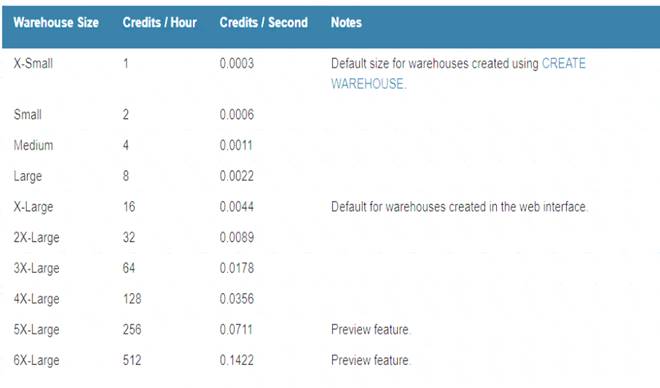
https://docs.snowflake.com/en/user-guide/warehouses-overview.html
NEW QUESTION 12
What is the minimum Snowflake edition that customers planning on storing protected information in Snowflake should consider for regulatory compliance?
- A. Standard
- B. Premier
- C. Enterprise
- D. Business Critical Edition
Answer: D
Explanation:
Reference: https://docs.snowflake.com/en/user-guide/intro-editions.html
NEW QUESTION 13
True or False: Users are able to see the result sets of queries executed by other users that share their same role.
- A. True
- B. False
Answer: B
Explanation:
Reference: https://docs.snowflake.com/en/user-guide/security-access-control-considerations.html
NEW QUESTION 14
By default, which Snowflake role is required to create a share?
- A. ORGADMIN
- B. SECURITYADMIN
- C. SHAREADMIN
- D. ACCOUNTADMIN
Answer: C
NEW QUESTION 15
True or False: Snowflake charges a premium for storing semi-structured data.
- A. True
- B. False
Answer: B
Explanation:
Reference:
https://snowflakecommunity.force.com/s/question/0D50Z00008ckwNuSAI/does-snowflakecharges- premium-for-storing-semi-structured-data
NEW QUESTION 16
......
Recommend!! Get the Full SnowPro-Core dumps in VCE and PDF From Certleader, Welcome to Download: https://www.certleader.com/SnowPro-Core-dumps.html (New 605 Q&As Version)