Pass4sure offers free demo for 2V0-21.23 exam. "VMware vSphere 8.x Professional", also known as 2V0-21.23 exam, is a VMware Certification. This set of posts, Passing the VMware 2V0-21.23 exam, will help you answer those questions. The 2V0-21.23 Questions & Answers covers all the knowledge points of the real exam. 100% real VMware 2V0-21.23 exams and revised by experts!
Free demo questions for VMware 2V0-21.23 Exam Dumps Below:
NEW QUESTION 1
When configuring vCenter High Availability (HA), which two statements are true regarding the active, passive, and witness nodes? (Choose two.)
- A. Network latency must be less than 10 milliseconds.
- B. They must have a supported Wide Area Network (WAN).
- C. They must have a minimum of a 10 Gbps network adapter
- D. They must have a minimum of a 1 Gbps network adapter.
- E. Network latency must be more than 10 milliseconds.
Answer: AD
Explanation:
When configuring vCenter High Availability (HA), two of the requirements for the active, passive, and witness nodes are that network latency must be less than 10 milliseconds, which ensures reliable communication between them; and they must have a minimum of a 1 Gbps network adapter, which provides sufficient bandwidth for data replication.
References:
https://docs.vmware.com/en/VMware-vSphere/7.0/com.vmware.vsphere.avail.doc/GUID-F01B2F12-C5BB-4C5
NEW QUESTION 2
Refer to the exhibit.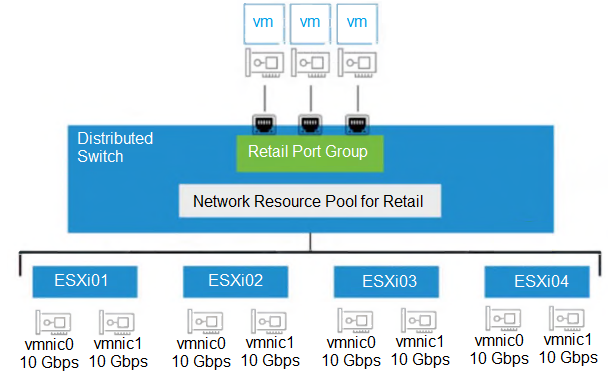
An administrator set up the following configuration:
• The distributed switch has four ESXi hosts, and each host has two 10 Gbps NICs.
• In the Network I/O Control configuration, the amount of bandwidth reserved for virtual machine (VM) traffic if 4 Gbps.
The administrator wants to guarantee that VMs in the Retail distributed port group can access 50 percent of the available reserved bandwidth for VM traffic.
Given this scenario, what should the size (in Gbps) of the Retail network resource pool be?
- A. 40
- B. 32
- C. 8
- D. 16
Answer: D
Explanation:
4Gbps*8Nic=32Gbps*50%=16Gbps
NEW QUESTION 3
An administrator is tasked with adding two additional hosts into an existing production vSphere cluster to support the need for additional capacity.
The vSphere cluster currently has four identically configured ESXi hosts (esxOT esx02. esx03 and esx04) that utilize Intel Skylake-based CPUs. The two new hosts (esx05 and esx06) are configured identically in terms of memory and storage to the existing hosts: but utilize Intel Ice Lake-based CPUs.
The administrator must ensure that:
•Any virtual machine migrates to any of the six ESXi hosts running in the cluster.
•There is no virtual machine downtime during the process of adding the new hosts. Which step should the administrator take to meet these requirements?
- A. Create a new vSphere cluster with Enhanced vMotion Compatibility (EVC) enabled and move all hosts into A' the new cluster
- B. Create a new vSphere cluster and move only three hosts into the new cluster.
- C. Configure Enhanced vMotion Compatibility (EVC) mode on the existing cluster and add the two new hosts into the cluster.
- D. Create a new vSphere cluster with vSphere High Availability (HA) enabled and move all hosts into the new cluster
Answer: C
Explanation:
The step that the administrator should take to meet these requirements is to configure Enhanced vMotion Compatibility (EVC) mode on the existing cluster and add the two new hosts into the cluster. EVC mode allows migration of virtual machines between different generations of CPUs by masking unsupported processor features. EVC mode can be enabled on an existing cluster without affecting powered-on virtual machines. References:
https://docs.vmware.com/en/VMware-vSphere/7.0/com.vmware.vsphere.vcenterhost.doc/GUID-9F444D9B-44A
https://blogs.vmware.com/vsphere/2019/06/enhanced-vmotion-compatibility-evc-explained.html
NEW QUESTION 4
An administrator creates a virtual machine that contains the latest company-approved software, tools and security updates. Company policy requires that only full clones are allowed for server workloads.
A combination of which two tasks should the administrator complete to prepare for the deployment of this virtual machine for multiple users? (Choose two.)
- A. Set appropriate permissions on the virtual machine.
- B. Create a virtual machine customization specification.
- C. Upgrade the virtual hardware.
- D. Convert the virtual machine to a template.
- E. Take a snapshot of the virtual machine.
Answer: BD
Explanation:
Option B and D are correct because they allow the administrator to create a virtual machine customization
specification, which can be used to customize guest operating system settings for multiple virtual machines, and convert the virtual machine to a template, which can be used to create full clones of server workloads. Option A is incorrect because assigning appropriate permissions on the virtual machine does not prepare it for deployment for multiple users. Option C is incorrect because upgrading the virtual hardware does not prepare it for deployment for multiple users. Option E is incorrect because taking a snapshot of the virtual machine does not prepare it for deployment for multiple users. References:
https://docs.vmware.com/en/VMware-vSphere/7.0/com.vmware.vsphere.vm_admin.doc/GUID-9F9E3F8C-0E2
NEW QUESTION 5
An administrator has been notified that a number of hosts are not compliant with the company policy for time synchronization.
The relevant portion of the policy states:
• All physical servers must synchronize time with an external time source that is accurate to the microsecond. Which step should the administrator take to ensure compliance with the policy?
- A. Ensure that each vCenter Server Appliance is configured to use a Network Time Protocol (NTP) source.
- B. Ensure that each ESXi host is configured to use a Precision Time Protocol (PTP) source.
- C. Ensure that each ESXi host is configured to use a Network Time Protocol (NTP) source.
- D. Ensure that each vCenter Server Appliance is configured to use a Precision Time Protocol (PTP) source.
Answer: B
Explanation:
To comply with the policy of synchronizing time with an external source that is accurate to the microsecond, the administrator needs to ensure that each ESXi host is configured to use a PTP source, which provides higher accuracy than NTP.
References:
https://docs.vmware.com/en/VMware-vSphere/7.0/com.vmware.vsphere.vcenterhost.doc/GUID-F7DF1DD3-E3
NEW QUESTION 6
An administrator is asked to segregate virtual machine (VM) traffic by VLAN on a vSphere standard switch The following requirements must be met:
•VLAN ID on the switch port group must be 4095.
•VLAN tagging must be done at the VM level. Which tagging mode is required?
- A. External Switch Tagging (EST)
- B. None
- C. Virtual Guest Tagging (VGT)
- D. Virtual Switch Tagging (VST)
Answer: C
Explanation:
The tagging mode that is required is Virtual Guest Tagging (VGT), which allows VLAN tagging to be done at the VM level. VGT requires that the VLAN ID on the switch port group be set to 4095, which is a special value that indicates that packets from all VLANs are allowed to pass through. References:
https://docs.vmware.com/en/VMware-vSphere/7.0/com.vmware.vsphere.networking.doc/GUID-D35A0A1C-B6
https://kb.vmware.com/s/article/1003806
NEW QUESTION 7
An administrator is tasked with implementing a backup solution capable of backing up the Su-pervisor cluster, vSphere Pods, and persistent volumes.
Which two solutions must be used to meet this requirement? (Choose two.)
- A. VMware vCenter
- B. Standalone Velero and Restic
- C. NSX-T Manager
- D. vSphere Host Client
- E. Velero Plugin for vSphere
Answer: BE
Explanation:
https://docs.vmware.com/en/VMware-vSphere/7.0/vmware-vsphere-with-tanzu/GUID-9816E07A-466C-451D-A
NEW QUESTION 8
An administrator is preparing for a deployment of a new vCenter Server Appliance. The following information has been provided to complete the deployment:
•ESXi Host name (FQDN): esxOl.corp local . ESXi IP Address: 172.20.10.200
•vCenter Server Name (FQDN): vcsa01 corp.local
•vCenter Server IP Address: 172.20 10.100
•NTP Server: 172.20.10.20
•DNS Server: 172.20.10.1
•Deployment Size: Tiny
•Storage Size: Default
Which two actions must the administrator complete before starting the installation of the vCenter Server Appliance? (Choose two.)
- A. Create a DNS CNAME record for the vCenter Server (vcsa01.corp.local)
- B. Create a DNS CNAME record for the ESXi Host server (esx01.corp.local)
- C. Create a reverse DNS A record for the vCenter Server (vcsa01).
- D. Create a reverse DNS A record for the ESXi Host server (esx01)
- E. Create a forward DNS A record for the vCenter Server (vcsa01).
Answer: CE
Explanation:
The administrator must create a forward DNS A record for the vCenter Server (vcsa01), which maps the FQDN of the vCenter Server to its IP address. The administrator must also create a reverse DNS A record for the ESXi Host server (esx01), which maps the IP address of the ESXi Host to its FQDN. These DNS records are required for name resolution and certificate validation during the deployment of the vCenter Server Appliance. References:
https://docs.vmware.com/en/VMware-vSphere/7.0/com.vmware.vcenter.install.doc/GUID-88571D8A-46E1-464
https://docs.vmware.com/en/VMware-vSphere/8.0/vsphere-vcenter-upgrade/GUID-752FCA83-1A9B-499E-9C6 If you plan to use an FQDN for the appliance system name, you must verify that the FQDN is resolvable by a DNS server, by adding forward and reverse DNS A records.
NEW QUESTION 9
Refer to Exhibit: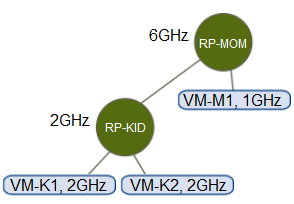
An environment has the following configuration:
•Resource Pool “RP-MOM? has a reservation of 6GHz and one running virtual machine (VM) "VM-M1? with 1 GHz reserved
•Resource Pool ^RP-KID? has a reservation of 2GHz, and expandable reservations is activated
The administrator creates two VMs, “VM-K1? and 'VM-K2?, in the ''RP-KID? resource pool with 2GHz reserved for each, and turns on “VM-M1 ?
Given this scenario, which statement is true?
- A. The administrator must deactivate expandable reservations to turn on VM-K2
- B. The administrator can create a third VM ( VM-K3?) at RP-KID and reserve 6GHz
- C. VM-K2 can be powered on because it can get the resources needed from RP-MOM.
- D. VM-K2 cannot be powered on because there are not enough resources in RP-KID.
Answer: C
Explanation:
https://docs.vmware.com/en/VMware-vSphere/8.0/vsphere-resource-management/GUID-60077B40-66FF-4625
NEW QUESTION 10
An administrator is tasked with applying updates to a vSphere cluster running vSAN using vSphere Lifecycle Manager. Downtime to the ESXI hosts must be minimal while the work Is completed.
The administrator has already completed the following steps and no errors have been returned:
• Downloaded all applicable software and created a new Image
• Attached the new Image to the cluster and run a compliance check against the Image for the cluster
• Ran a remediation pre-check for the cluster
Which two series of steps should the administrator perform to start the remediation of the cluster using the new image? (Choose two.)
- A. * 1. Use the Remediate option in vSphere Lifecycle Manager to remediate all of the ESXI hosts in the cluster in parallel.* 2. Allow vSphere Lifecycle Manager to automatically control maintenance mode on the ESXI hosts.
- B. * 1. Place each of the ESXI hosts into maintenance mode manually.* 2. Use the Stage option in vSphere Lifecycle Manager to stage the required software on all ESXi hosts one at a time.
- C. * 1. Leave all ESXI hosts in the cluster operational.* 2. Use the Stage All option in vSphere Lifecycle Manager to stage the required software onto all ESXI hosts one at a time.
- D. * l Leave all ESXI hosts in the cluster operational* 2. Use the Stage All option in vSphere Lifecycle Manager to stage the required software onto all ESXI hosts in the cluster In parallel.
- E. * 1 Use the Remediate Option In vSphere Lifecycle Manager to remediate all of the ESXI hosts In the cluster In sequence.* 2. Allow vSphere Lifecycle Manager to automatically control maintenance mode on the ESXI hoy
Answer: AD
Explanation:
Option A and D are correct because they allow vSphere Lifecycle Manager to automatically control maintenance mode on the ESXi hosts and remediate them in parallel or in sequence. Option B and C are incorrect because they require manual intervention to place the hosts into maintenance mode or to stage the software on each host, which is not efficient or minimal downtime. References: https://docs.vmware.com/en/VMware-vSphere/7.0/com.vmware.vsphere-lifecycle-manager.doc/GUID-9F9E3F8
NEW QUESTION 11
An administrator is asked to configure a security policy at the port group level of a standard switch. The following requirements must be met:
• The security policy must apply to all virtual machines on portgroup-1.
• All traffic must be forwarded, regardless of the destination.
- A. Forged transmits set to reject
- B. MAC address changes set to accept
- C. Promiscuous mode set to reject
- D. Promiscuous mode set to accept
Answer: D
Explanation:
The security policy that must be configured at the port group level to allow all traffic to be forwarded regardless of the destination is promiscuous mode set to accept, which allows receiving all traffic on a virtual switch port.
References:
https://docs.vmware.com/en/VMware-vSphere/7.0/com.vmware.vsphere.networking.doc/GUID-D5960C77-0D1
NEW QUESTION 12
An administrator needs to configure a content library solution based on the following information:
•A new corporate virtual machine (VM) template is created every month to include all of the latest patches.
•The new VM template should be downloaded from the primary data center site (London) to two secondary data center sites (Tokyo and New York) as soon as possible.
•There is limited disk space available at one of the secondary data center sites (Tokyo) due to an ongoing data center consolidation project.
Which four steps should the administrator take to configure the content library solution before adding a VM template? (Choose four.)
- A. Create a new published content library In each secondary site
- B. Configure the New York subscribed content library to download content immediately.
- C. Configure the Tokyo subscribed content library to download content immediately
- D. Configure the Tokyo subscribed content library to download content when needed
- E. Create a new published content library at the primary site
- F. Configure the New York subscribed content library to download content when needed.
- G. Create a new subscribed content library in each secondary site
Answer: BDEG
Explanation:
The administrator should take these four steps to configure the content library solution before adding a VM template: Create a new published content library at the primary site, which allows the administrator to share the VM template with other sites. Configure the New York subscribed content library to download content immediately, which ensures
that the new VM template is downloaded from the primary site as soon as possible. Configure the Tokyo subscribed content library to download content when needed, which saves disk space at the secondary site by downloading only the metadata of the VM template until it is deployed. Create a new subscribed content library in each secondary site, which allows the administrator to subscribe to the published content library at the primary site and synchronize the VM template. References:
https://docs.vmware.com/en/VMware-vSphere/7.0/com.vmware.vsphere.vm_admin.doc/GUID-E8E854D
NEW QUESTION 13
An administrator is investigating reports of users experiencing difficulties logging into a VMware vCenter instance using LDAP accounts.
Which service should the administrator check as part of troubleshooting?
- A. vSphere Authentication Proxy Service
- B. Lookup Service
- C. Identity Management Service
- D. VMware Authentication Framework Daemon
Answer: C
Explanation:
Identity Management Service is the service that handles authentication requests from LDAP accounts and other identity sources in vCenter Server.
References:
https://docs.vmware.com/en/VMware-vSphere/7.0/com.vmware.vcenter.install.doc/GUID-FE1D5F2E-E3AC-4D
NEW QUESTION 14
An administrator needs to consolidate a number of physical servers by migrating the workloads to a software-defined data center solution.
Which VMware solution should the administrator recommend?
- A. VMware Horizon
- B. VMware vSAN
- C. VMware vSphere
- D. VMware
Answer: C
Explanation:
Option C is correct because VMware vSphere is the solution that provides a software-defined data center platform that can consolidate physical servers by migrating the workloads to virtual machines. Option A is incorrect because VMware Horizon is a solution for virtual desktop infrastructure (VDI) and application delivery. Option B is incorrect because VMware vSAN is a solution for software-defined storage that is integrated with vSphere. Option D is incorrect because VMware NSX is a solution for software-defined networking that is integrated with vSphere. References: https://www.vmware.com/products/vsphere.html
NEW QUESTION 15
Refer to the exhibit.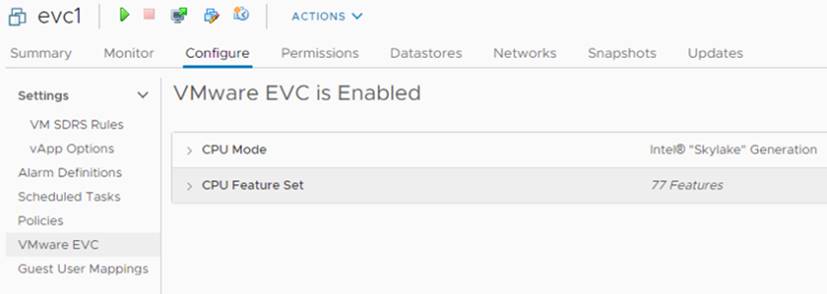
An administrator is tasked with adding new capacity to an existing software-defined data center (SDDC).
• The SDDC currently hosts two vSphere clusters (ClusterA and ClusterB) with different CPU compatibilities.
• vSphere vMotion and vSphere Distributed Resource Scheduler (DRS) are currently in use in the SDDC.
• The new capacity will be implemented by provisioning four ESXi hosts running a new generation of Intel Skylake CPUs.
• All workload virtual machines (VMs) must support live migration to any cluster in the SDDC.
The administrator noticed the running critical "ever virtual machine (VM) shown in the exhibit is not migrating using vSphere vMotion to the original Clusters A or B.
Which three steps must the administrator take to support this functionality? (Choose three.)
- A. Power on the VM.
- B. Disable the Enhanced vMotion Compatibility (EVC) on the VM.
- C. Reboot the VM.
- D. Configure the Enhanced vMotion Compatibility (EVC) on vSphere Cluster A and B to support Intel Skylake.
- E. Power off the VM.
- F. Configure the Enhanced vMotion Compatibility (EVC) on the VM to Intel Skylake.
Answer: ADE
NEW QUESTION 16
Which two datastore types store the components of a virtual machine as a set of objects? (Choose two.)
- A. VMware Virtual Machine File System (VMFS)
- B. VMware vSAN
- C. Network File System (NFS) 3
- D. vSphere Virtual Volumes (vVols)
- E. Network File System (NFS) 4.1
Answer: BD
Explanation:
Option B and D are correct because they are the datastore types that store the components of a virtual machine as a set of objects, which are logical containers that abstract physical storage resources. Option A, C and E are incorrect because they are the datastore types that store the components of a virtual machine as a set of files, which are stored on a file system that resides on a physical storage device. References: https://docs.vmware.com/en/VMware-vSphere/7.0/com.vmware.vsphere.storage.doc/GUID-9F9E3F8C-0E2B-4
NEW QUESTION 17
Which three vSphere features are still supported for Windows-based virtual machines when enabling vSphere's -virtualization-based security feature? (Choose three.)
- A. vSphere vMotion
- B. PCI passthrough
- C. vSphere High Availability (HA) D, vSphere Fault Tolerance
- D. vSphere Distributed Resources Scheduler (DRS)
- E. Hot Add of CPU or memory
Answer: ACE
Explanation:
Option A, C and E are correct because they indicate that vSphere features such as vMotion, High Availability (HA) and Distributed Resource Scheduler (DRS) are still supported for Windows-based virtual machines when enabling vSphere’s virtualization-based security feature, which provides enhanced protection for guest operating systems and applications against various attacks. Option B is incorrect because PCI passthrough is not supported for Windows-based virtual machines when enabling vSphere’s virtualization-based security feature, as this feature requires direct access to physical devices that cannot be shared or protected by hypervisor mechanisms. Option D is incorrect because Fault Tolerance is not supported for Windows-based virtual machines when enabling vSphere’s virtualization-based security feature, as this feature requires identical execution states for primary and secondary virtual machines that cannot be guaranteed by hypervisor mechanisms. Option F is incorrect because Hot Add of CPU or memory is not supported for Windows-based virtual machines when enabling vSphere’s virtualization-based security feature, as this feature requires
dynamic changes to virtual hardware configuration that cannot be handled by hypervisor mechanisms. References:
https://docs.vmware.com/en/VMware-vSphere/7.0/com.vmware.vsphere.security.doc/GUID-A2A4371A-B888
NEW QUESTION 18
An administrator is preparing to perform an update to vSphere clusters that are running vSAN. The administrator wants to ensure that the following requirements are met as part of the update:
•All hosts in the cluster are updated with the same software.
•The firmware versions on the hosts are updated
•The new software versions are checked for compliance against the vSAN Hardware Compatibility List. Which three steps should the administrator take to meet these requirements? (Choose three.)
- A. Configure vSphere Lifecycle Manager with an image for the cluster.
- B. Register the vendor hardware management system as a vCenter Server extension.
- C. Download the firmware updates from the VMware website
- D. Download the firmware updates from the vendor website.
- E. Run a hardware compatibility check using vSphere Lifecycle Manager
- F. Configure vSphere Lifecycle Manager with a baseline for the cluster.
Answer: ABE
Explanation:
The administrator should take these three steps to perform an update to vSphere clusters that are running vSAN: Configure vSphere Lifecycle Manager with an image for the cluster, which allows the administrator to specify the desired ESXi version and firmware for the hosts in the cluster.
 Register the vendor hardware management system as a vCenter Server extension, which allows the administrator to update the firmware on the hosts using vSphere Lifecycle Manager. The vendor hardware management system can also provide the firmware updates to vSphere Lifecycle Manager, so there is no need to download them from the vendor website separately. Run a hardware compatibility check using vSphere Lifecycle Manager, which verifies that the new software and firmware versions are compatible with the vSAN Hardware Compatibility List.
NEW QUESTION 19
......
P.S. Easily pass 2V0-21.23 Exam with 107 Q&As Certshared Dumps & pdf Version, Welcome to Download the Newest Certshared 2V0-21.23 Dumps: https://www.certshared.com/exam/2V0-21.23/ (107 New Questions)