Act now and download your Cisco 350-401 test today! Do not waste time for the worthless Cisco 350-401 tutorials. Download Regenerate Cisco Implementing and Operating Cisco Enterprise Network Core Technologies exam with real questions and answers and begin to learn Cisco 350-401 with a classic professional.
Online Cisco 350-401 free dumps demo Below:
NEW QUESTION 1
DRAG DROP
Drag and drop the description of the VSS technology from the left to the right. NOT all options are used.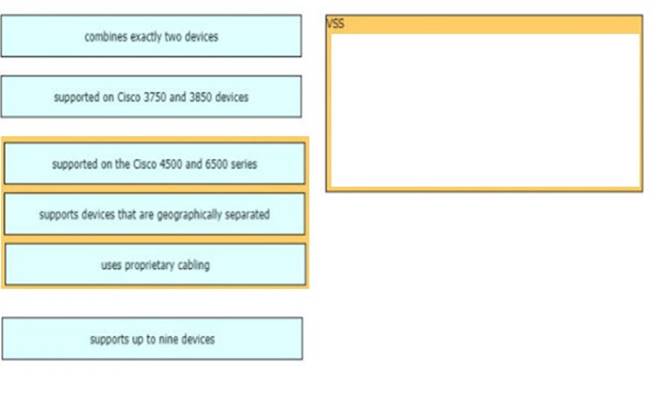
Solution:
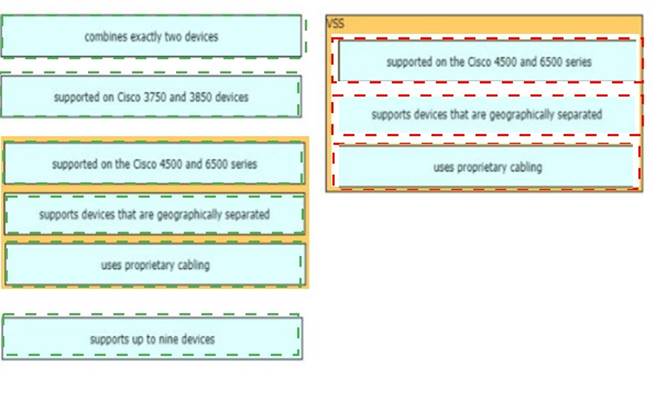
Does this meet the goal?
- A. Yes
- B. Not Mastered
Answer: A
NEW QUESTION 2
When is an external antenna used inside a building?
- A. only when using Mobility Express
- B. when it provides the required coverage
- C. only when using 2 4 GHz
- D. only when using 5 GHz
Answer: B
NEW QUESTION 3
Refer to the exhibit.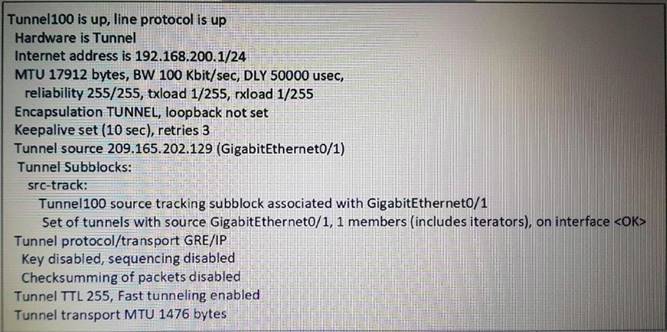
A network engineer configures a GRE tunnel and enters the show Interface tunnel command. What does the output confirm about the configuration?
- A. The keepalive value is modified from the default value.
- B. Interface tracking is configured.
- C. The tunnel mode is set to the default.
- D. The physical interface MTU is 1476 bytes.
Answer: C
NEW QUESTION 4
what is a benefit of using a Type 2 hypervisor instead of a Type 1 hypervisor?
- A. better application performance
- B. Improved security because the underlying OS is eliminated
- C. Improved density and scalability
- D. ability to operate on hardware that is running other OSs
Answer: D
NEW QUESTION 5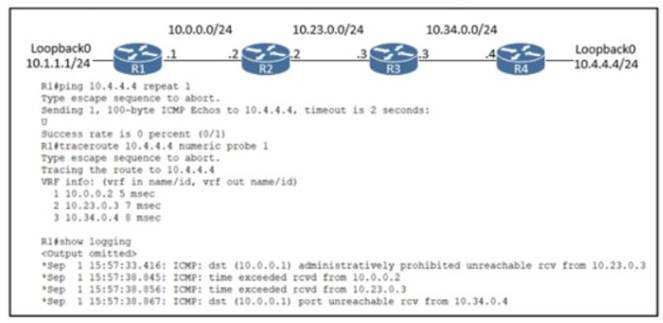
Refer to the exhibit. What is the cause of the communication failure between R1 and R4?
- A. R1 is configured with the no ip unreachables command.
- B. R2 is denying ICMP
- C. R4 is denying ICMP.
- D. R3 is denying ICMP.
Answer: A
NEW QUESTION 6
A client device roams between access points located on different floors in an atrium. The access points are Joined to the same controller and configured in local mode. The access points are in different AP groups and have different IP addresses, but the client VLAN in the groups is the same. Which type of roam occurs?
- A. inter-controller
- B. inter-subnet
- C. intra-VLAN
- D. intra-controller
Answer: D
Explanation:
Mobility, or roaming, is a wireless LAN client’s ability to maintain its association seamlessly from one access point to another securely and with as little latency as possible. Three popular types of client roaming are:
Intra-Controller Roaming: Each controller supports same-controller client roaming across access points managed by the same controller. This roaming is transparent to the client as the session is sustained, and the client continues using the same DHCP-assigned or client-assigned IP address.
Inter-Controller Roaming: Multiple-controller deployments support client roaming across access points managed by controllers in the same mobility group and on the same subnet. This roaming is also transparent to the client because the session is sustained and a tunnel between controllers allows the client to continue using the same DHCP- or client-assigned IP address as long as the session remains active. Inter-Subnet Roaming: Multiple-controller deployments support client roaming across access points managed by controllers in the same mobility group on different subnets. This roaming is transparent to the client because the session is sustained and a tunnel between the controllers allows the client to continue using the same DHCP-assigned or client-assigned IP address as long as the session remains active. Reference: https://www.cisco.com/c/en/us/td/docs/wireless/controller/7-4/configuration/guides/consolidated/b_cg74_CONSOLIDATED/b_cg74_CONSOLID ATED_chapter_01100.html
In three types of client roaming above, only with Inter-Subnet Roaming the controllers are in different subnets.
NEW QUESTION 7
DRAG DROP
Drag and drop the snippets onto the blanks within the code to create an EEM script that adds an entry to a locally stored text file with a timestamp when a configuration change is made. Not all options are used.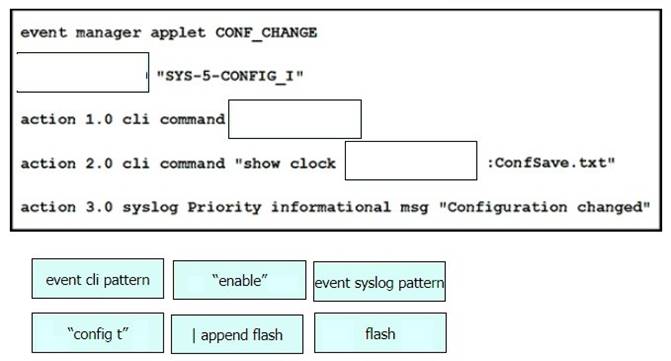
Solution:
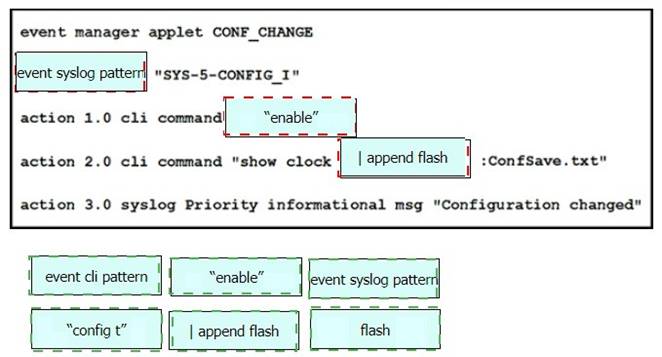
Does this meet the goal?
- A. Yes
- B. Not Mastered
Answer: A
NEW QUESTION 8
How must network management traffic be treated when defining QoS policies?
- A. as delay-sensitive traffic in a low latency queue
- B. using minimal bandwidth guarantee
- C. using the same marking as IP routing
- D. as best effort
Answer: A
Explanation:
Low latency queuing (LLQ) adds a priority queue to CBWFQ from which delay-sensitive traffic, such as voice traffic, can be transmitted ahead of packets in other queues.
By configuring the quality of service (QoS), you can provide preferential treatment to specific types of traffic at the expense of other traffic types. Without QoS, the device offers best-effort service for each packet, regardless of the packet contents or size. The device sends the packets without any assurance of reliability, delay bounds, or throughput.
The following are specific features provided by QoS:
✑ Low latency
✑ Bandwidth guarantee
✑ Buffering capabilities and dropping disciplines
✑ Traffic policing
✑ Enables the changing of the attribute of the frame or packet header
✑ Relative services
✑ Modular QoS Command-Line Interface
✑ Supported QoS Features for Wired Access
✑ Hierarchical QoS
NEW QUESTION 9
Refer to the exhibit.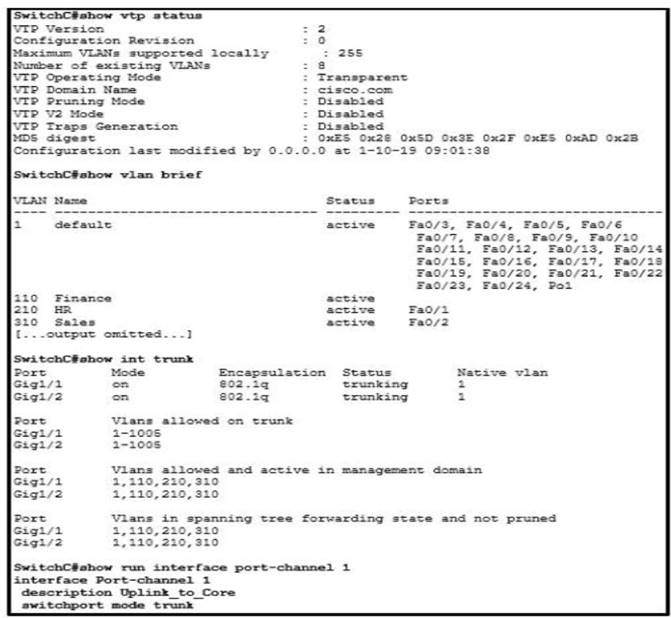
SwitchC connects HR and Sales to the Core switch However, business needs require that no traffic from the Finance VLAN traverse this switch Which command meets this requirement?
A)
B)
C)
D)
- A. Option A
- B. Option B
- C. Option C
- D. Option D
Answer: D
NEW QUESTION 10
Refer to the exhibit.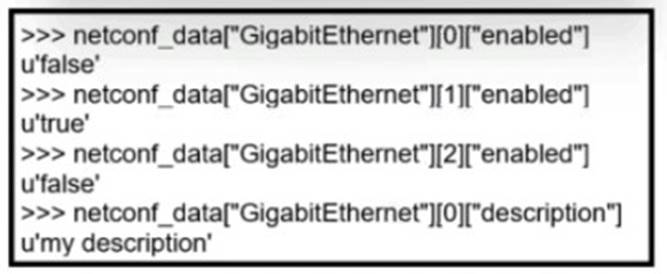
Which Python code snippet prints the descriptions of disabled interfaces only?
A)
B)
C)
D)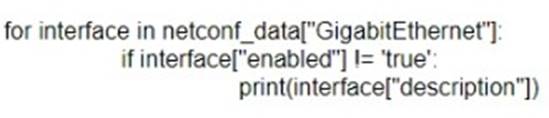
- A. Option A
- B. Option B
- C. Option C
- D. Option D
Answer: D
NEW QUESTION 11
How does Cisco Express Forwarding switching differ from process switching on Cisco devices?
- A. Cisco Express Forwarding switching uses adjacency tables built by the CDP protocol, and process switching uses the routing table.
- B. Cisco Express Forwarding switching uses dedicated hardware processors, and process switching uses the main processor.
- C. Cisco Express Forwarding swithing saves memory by storing adjacency tables in dedicated memory on the line cards, and process switching stores all tables in the main memory.
- D. Cisco Express Forwarding switching uses a proprietary protocol based on IS-IS for MAC address lookup, and process switching uses the MAC address table.
Answer: C
NEW QUESTION 12
What is the function of a control-plane node In a Cisco SD-Access solution?
- A. to run a mapping system that manages endpoint to network device relationships
- B. to implement policies and communicate with networks outside the fabric
- C. to connect external Layer 3 networks to the SD-Access fabric
- D. to connect APs and wireless endpoints to the SD-Access fabric
Answer: A
NEW QUESTION 13
What is a benefit of a virtual machine when compared with a physical server?
- A. Multiple virtual servers can be deployed on the same physical server without having to buy additional hardware.
- B. Virtual machines increase server processing performance.
- C. The CPU and RAM resources on a virtual machine cannot be affected by other virtual machines.
- D. Deploying a virtual machine is technically less complex than deploying a physical server.
Answer: A
NEW QUESTION 14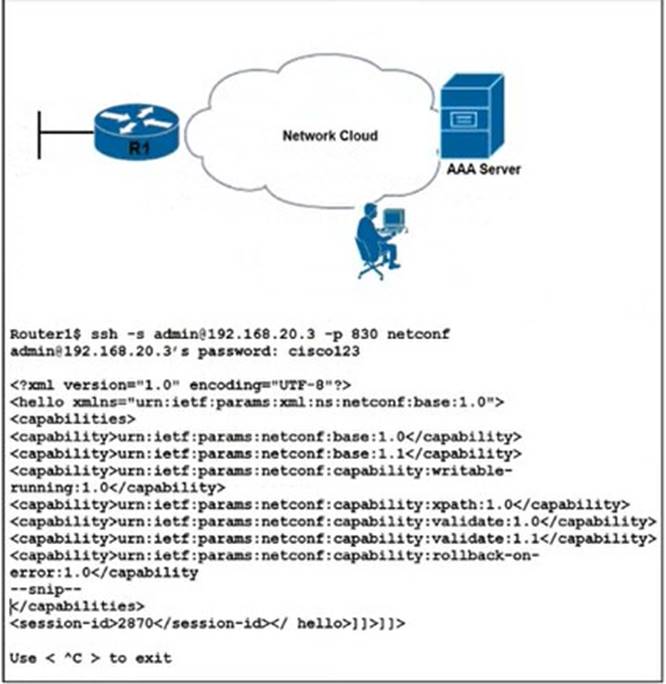
Refer to the exhibit. An engineer tries to log in to router R1. Which configuration enables a successful login?
A)
B)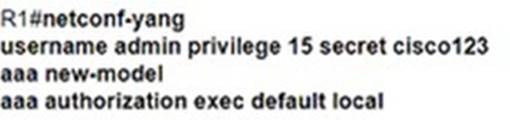
C)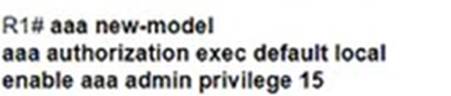
D)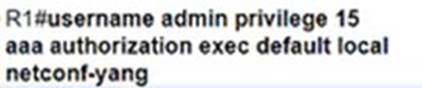
- A. Option A
- B. Option B
- C. Option C
- D. Option D
Answer: B
NEW QUESTION 15
Refer to the exhibit.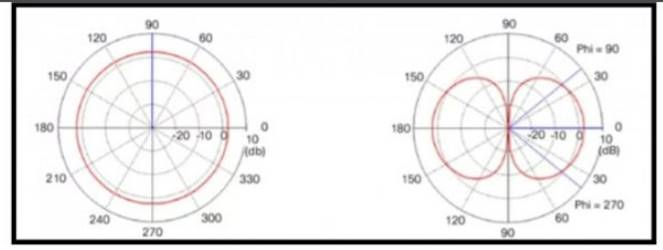
Which type of antenna is show on the radiation patterns?
- A. Dipole
- B. Yagi
- C. Patch
- D. Omnidirectional
Answer: A
NEW QUESTION 16
Which OSPF networks types are compatible and allow communication through the two peering devices?
- A. broadcast to nonbroadcast
- B. point-to-multipoint to nonbroadcast
- C. broadcast to point-to-point
- D. point-to-multipoint to broadcast
Answer: A
Explanation:
The following different OSPF types are compatible with each other:
+ Broadcast and Non-Broadcast (adjust hello/dead timers)
+ Point-to-Point and Point-to-Multipoint (adjust hello/dead timers)
Broadcast and Non-Broadcast networks elect DR/BDR so they are compatible. Point- topoint/multipoint do not elect DR/BDR so they are compatible.
NEW QUESTION 17
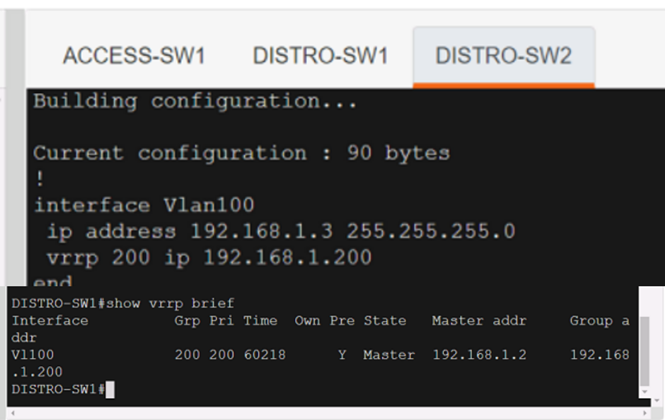
SIMULATION
Simulation 10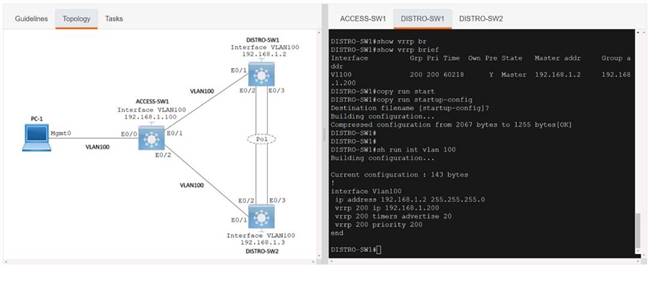
Solution:
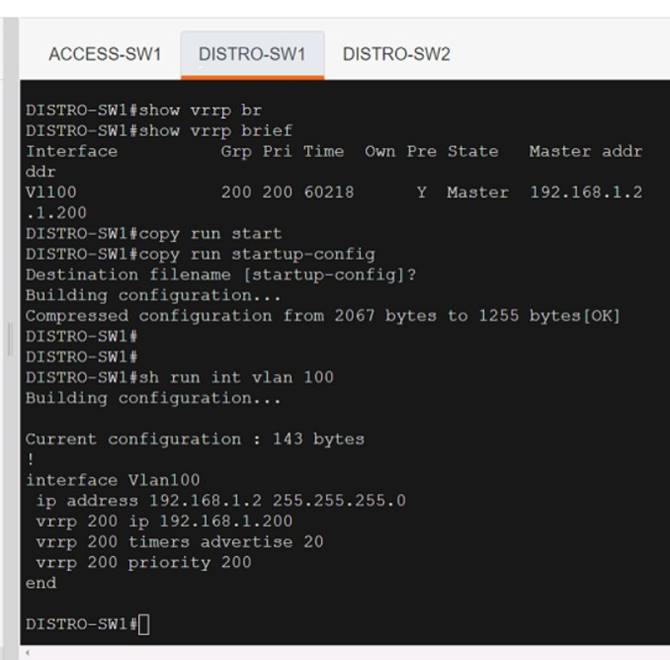
Does this meet the goal?
- A. Yes
- B. Not Mastered
Answer: A
NEW QUESTION 18
Refer to the exhibit.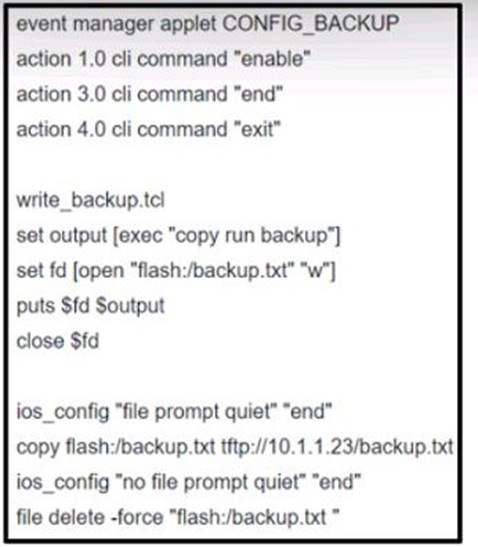
Which statement is needed to complete the EEM applet and use the Tel script to store the backup file?
- A. action 2.0 cli command "write_backup.tcl tcl"
- B. action 2.0 cli command "flash:write_backup.tcl"
- C. action 2.0 cli command "write_backup.tcl"
- D. action 2.0 cli command "telsh flash:write_backup.tcl"
Answer: B
Explanation:
This is because the EEM applet needs to specify the full path of the Tcl script that is stored in the flash memory of the device. The script name is write_backup.tcl and it is used to backup the running configuration to a remote server. The source of this answer is the Cisco ENCOR v1.1 course, module 8, lesson 8.3: Implementing Embedded Event Manager.
NEW QUESTION 19
Which AP mode allows an engineer to scan configured channels for rogue access points?
- A. sniffer
- B. monitor
- C. bridge
- D. local
Answer: B
NEW QUESTION 20
Which two security features are available when implementing NTP? (Choose two.)
- A. symmetric server passwords
- B. dock offset authentication
- C. broadcast association mode
- D. encrypted authentication mechanism
- E. access list-based restriction scheme
Answer: DE
NEW QUESTION 21
......
P.S. Dumps-files.com now are offering 100% pass ensure 350-401 dumps! All 350-401 exam questions have been updated with correct answers: https://www.dumps-files.com/files/350-401/ (188 New Questions)